Avadhuta Gita
Chapter 8 · The avadhuta’s close, and the meaning hidden in the letters a-va-dhu-ta
This song of eight chapters has now reached its end. First, Dattatreya asks God for an unusual forgiveness. By journeying on pilgrimage to him, he says, he has somehow hemmed in his all-pervadingness; by fixing him in meditation, he has confined the form that lies past the mind; by praising him, he has confined the form that lies past speech. Then he counts the inner marks of the avadhuta, and opens the letters “a-va-dhu-ta” one at a time. At the last comes the fruit of reading this Gita and hearing it.
The very summit of non-dual devotion opens here, at the point where every rite of worship turns into an offense. Dattatreya speaks to God. By traveling all the way to you, he says, I have shrunk your all-pervadingness, for what place is there to go toward the one who is already everywhere? By holding you in meditation, I have insulted the form that lies past the mind, for how can the mind bind what stands beyond its grasp? By praising you, I have insulted the form that lies past speech, for how can words gather in the one who lies past their reach? Forgive these three kinds of offense, always. Inside this plea for pardon the highest praise lies hidden.
1 · Pilgrimage, meditation, and praise: forgiveness for three offenses
By my pilgrimage to you, your all-pervadingness is undone; by my meditation, your nature beyond the mind is undone; by my praise, your nature beyond speech is undone. Forgive, always, these three offenses.
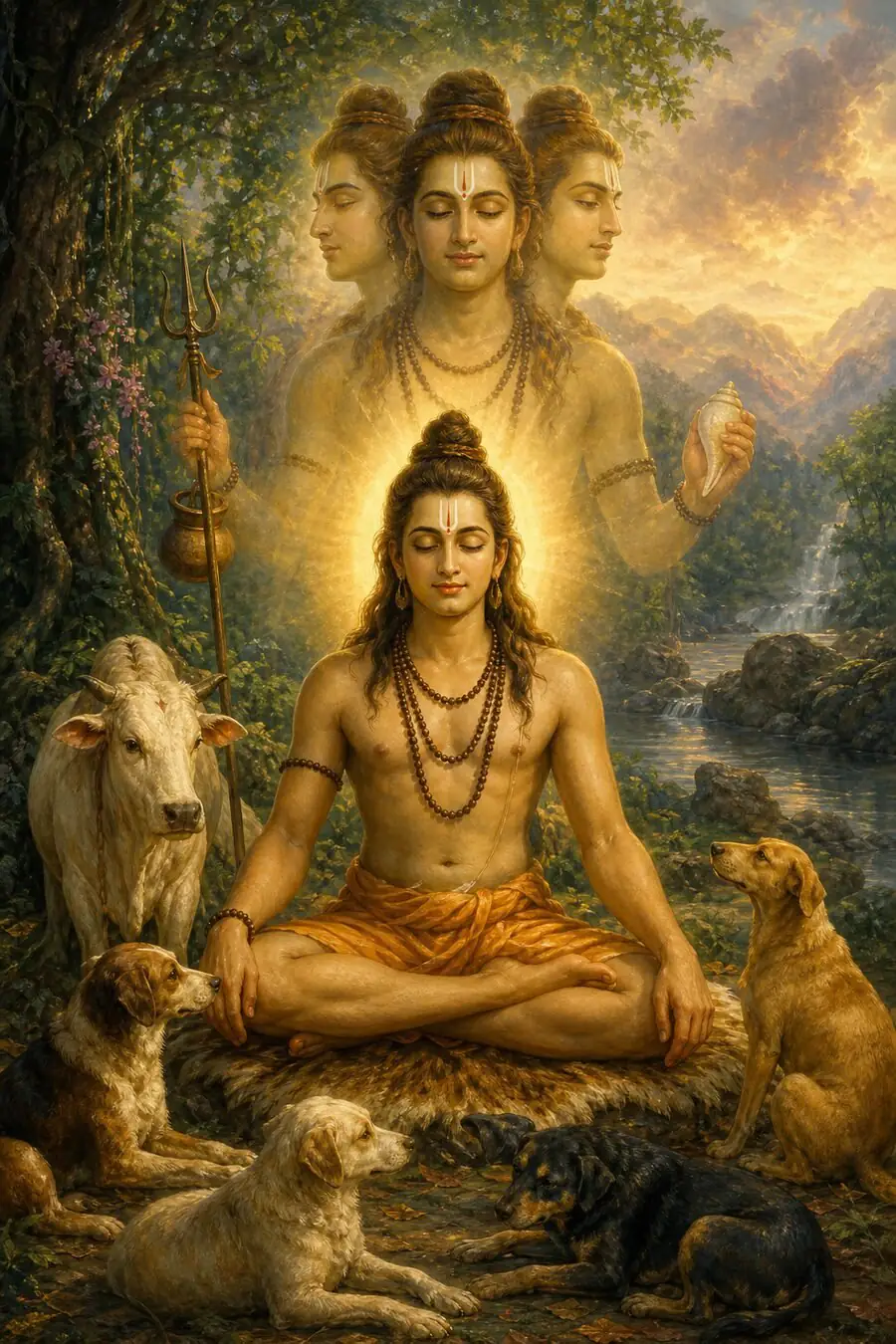
With the forgiveness asked, Dattatreya now draws the portrait of the sage men call the avadhuta. He may wear rags on the outside or wander sky-clad, and his true mark still sits within. Desire never shakes his understanding, his senses answer to him, his nature is gentle, his inner being is clean, and nothing at all is left for him to keep. Free of longing, eating little, calm and steady, that sage lives always in the shelter of God. Here having-nothing carries no taste of destitution; it is the total end of possession, a state where clinging finds no place to settle.
2 · Marks of the avadhuta sage: free of desire, self-controlled, gentle, pure, owning nothing
His mind unshaken by desire, his senses subdued, gentle, pure, owning nothing; free of striving, eating in measure, calm and steady, the sage takes refuge in me.
His inner portrait deepens. He stays watchful at all times, grave by nature, patient as a matter of course, and he has already conquered the six inner enemies: desire, anger, greed, delusion, pride, and envy. He wants not a trace of honor for himself, and he gives honor to others in full measure. This pairing, claiming no honor while granting it, sits at the center of his nature. He is capable, friendly, filled with compassion, and a poet in the Vedic sense, which is to say a seer who looks far into the distance.
3 · Watchful, grave of soul, patient, conqueror of the six passions, honoring others, friendly, compassionate
Ever vigilant, deep of soul, firm in patience, master of the six passions; claiming no honor yet granting it, capable, friendly, compassionate, a seer.
He is kind, and he bears ill will toward no one. All the pairs the world throws up, pleasure and pain, honor and dishonor, he endures without complaint, and for this he is called titiksu, the one who forbears. Truth is his very core, and his conduct leaves no opening anywhere for reproach. He looks on all living beings with one even gaze, and he works for the good of all. Whatever his way of living, his dealings stay clean from within and rooted in truth.
4 · Kind, free of ill will, forbearing, truth at his core, blameless, even-minded, benefactor of all
Kind, wishing harm to none, forbearing toward every embodied being; truth his core, his self beyond blame, even-eyed, a doer of good to all.
Now Dattatreya turns to an ancient method. The mark of the avadhuta lies hidden in the very letters of his name, and only certain people can read it: the finest devotees of God, those who know the syllables, the meaning, and the essence of the Veda, and those who have entered the heart of Veda and Vedanta. This is the old way of nirukta, where the essence of a word is held to rest inside its derivation. Now each letter of the word “avadhuta” will begin to open its meaning.
5 · The avadhuta’s mark, to be read from the letters, known to those who know Veda and Vedanta
The mark of the avadhuta is to be known through its letters by the greatest devotees, by those who know the syllable, the sense, and the truth of the Veda, by those who speak of Veda and Vedanta.
The first letter, “a,” holds three marks inside it. The one who has slipped free of the bonds of hope, whose beginning, middle, and end are without stain, and who rests always in bliss, he is the bearer of “a.” These three qualities are three faces of a single nature, and in Sanskrit each of the three words begins with the letter a: asha-pasha-vinirmukta, adi-madhyanta-nirmala, ananda.
6 · The letter “a”: free of hope’s snare, unstained in beginning, middle, and end, always in bliss
Loosed from the snare of hope, unstained through beginning, middle, and end, he abides always in bliss: the letter “a” is his mark.
The second letter, “va,” carries three marks as well, and in Sanskrit all three begin with “va”: vasana, vaktavya, vartamana. The one who has let go of his cravings, whose speech is unclouded, and who stays settled in the present, he is the bearer of “va.” To hold fast in the present is to rise above worry over past and future, until this moment alone stands as the real.
7 · The letter “va”: free of craving, pure of speech, settled in the present
Craving cast aside, his speech free of all disease, he moves within the present: the letter “va” is his mark.
Now the last letter, “ta,” arrives, and it too holds three marks. The one who has taken up the contemplation of truth, who is free of worldly worry and useless effort, and who is loosed from darkness and ego, he is the bearer of “ta.” The verse for the middle letter, “dhu,” is missing from the text given in this chapter. In the common text it stands as the eighth verse, and it names as the mark of “dhu” the one whose limbs are gray with dust, whose mind is washed clean, who is free of every ill, and who is free even of fixed concentration and meditation. Tradition ties “dhu” to dhuta, the shaken-off, meaning the one who has shaken away every attachment to the body along with attraction and aversion.
8 · The letter “ta”: settled in the contemplation of truth, free of worry and vain effort, loosed from darkness and ego
Holding the contemplation of truth, freed from worry and restless effort, loosed from darkness and ego: the letter “ta” is his mark.
Now comes the fruit-declaration that closes it all. Whoever reads this Gita, composed by Dattatreya the avadhuta whose very form is bliss, and whoever hears it, is born no more. On the plain reading this means release from the wheel of birth and death, though in the avadhuta’s sight the heart of it runs deeper. There is no rebirth, for birth and death never were at all. The atman, the self, is unborn, and reading this Gita and hearing it throws open that very unborn nature.
9 · Composed by Dattatreya the avadhuta whose form is bliss: no rebirth for those who read and hear
Made by Dattatreya the avadhuta, whose form is bliss: for those who read it and those who hear it, there is no rebirth at all.
The close
The Avadhuta Gita comes to its completion here. Across eight chapters it sings the supreme nature of the self, past all rule and prohibition. Dattatreya’s word here asks nothing of the rules of poetics and their polish. It reaches only toward that experience which words cannot so much as touch.