On this page
A Mortar, and Two Trees That Had Waited Years to Be Set Free
The child could walk now, and his mischief had grown with him. He and his brother roamed the whole of Vraja, into every cow-shed and every courtyard, and Nanda could not keep the two of them still for the length of an afternoon. Krishna stole butter and broke the clay pots, and when he was caught he turned up a face so innocent that the anger drained out of whoever was holding him. One morning Yashoda reached the end of her patience. Let me tie him for a little while, she thought, so he stays in one place and I can get my work done.
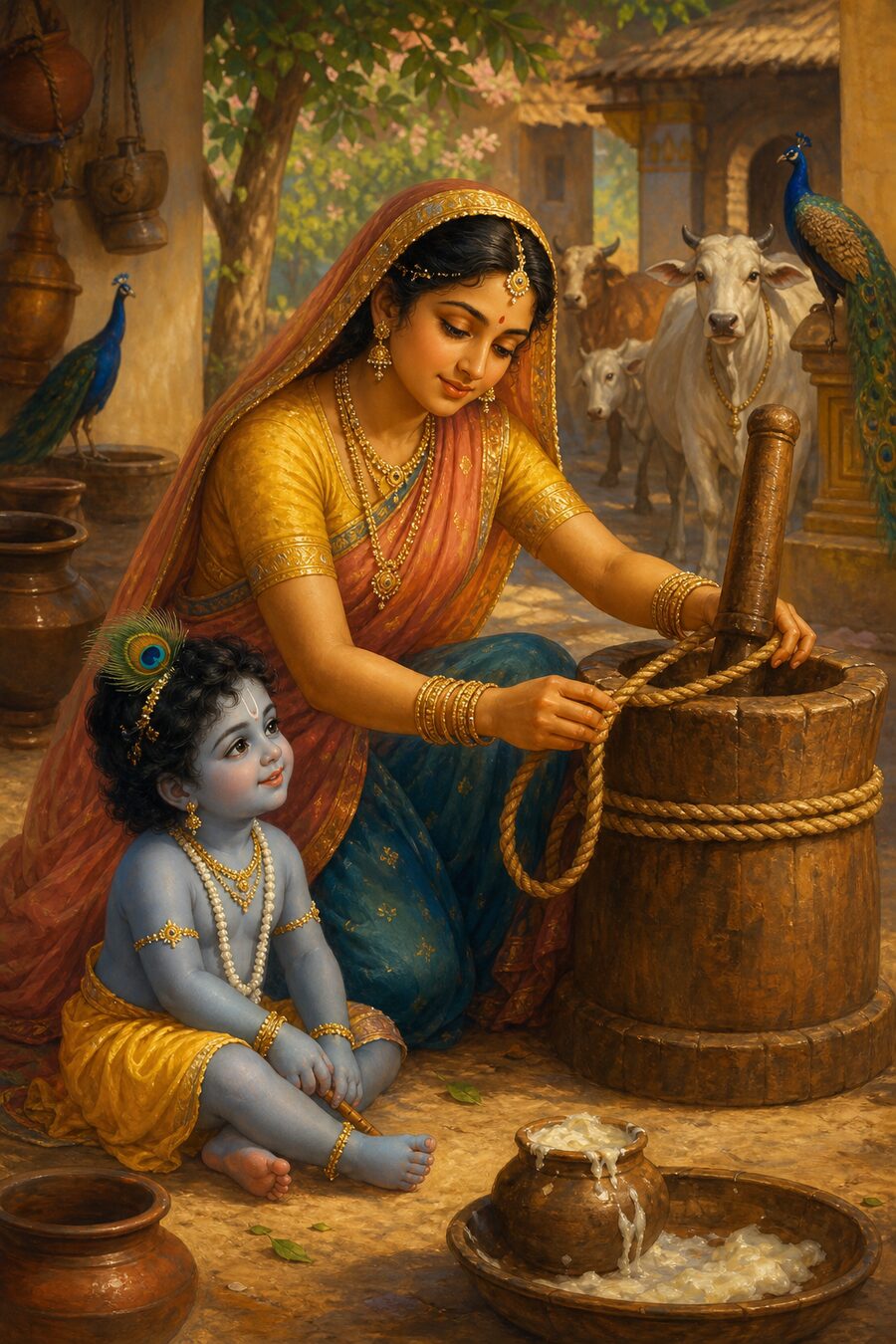
She took a length of rope and brought him over to the heavy wooden mortar the household used for husking rice. She looped the rope around his waist to fasten him to it, and then something odd happened. The rope came up short. She knotted on more, and it was still two fingers short. Again and again she added length, and every time the same two fingers were missing, as though that small body had never been meant to fit inside any measure at all. At last the child watched his mother work herself breathless and let himself be bound. Yashoda tied him to the mortar, and, still short of temper, she told him to drag it off if he thought he could. Then she turned back to her chores.
Two trees, and an old curse
Near that house, at the edge of the settlement, stood two immense arjuna trees, grown so close together that people called them the twin arjunas, the yamala-arjuna. They were older than anyone’s memory, tall enough to serve as landmarks, and the cowherds had taken to honoring them the way one honors a shrine, tying wishes to their trunks and asking for favors. No one alive knew their real story. A secret was folded inside that wood. The tellers say the two trees had once been two proud sons of the yakshas, giddy with their wealth and their beauty, who in the arrogance of their youth had insulted a great rishi. For that insult they were rooted where they stood and made to wait out the years as trees, and they were left one thread of hope to hold: a day would come, and a certain someone with it, whose touch would set them loose. They had been counting those years for longer than the village had stood.
A bound child, and falling trees
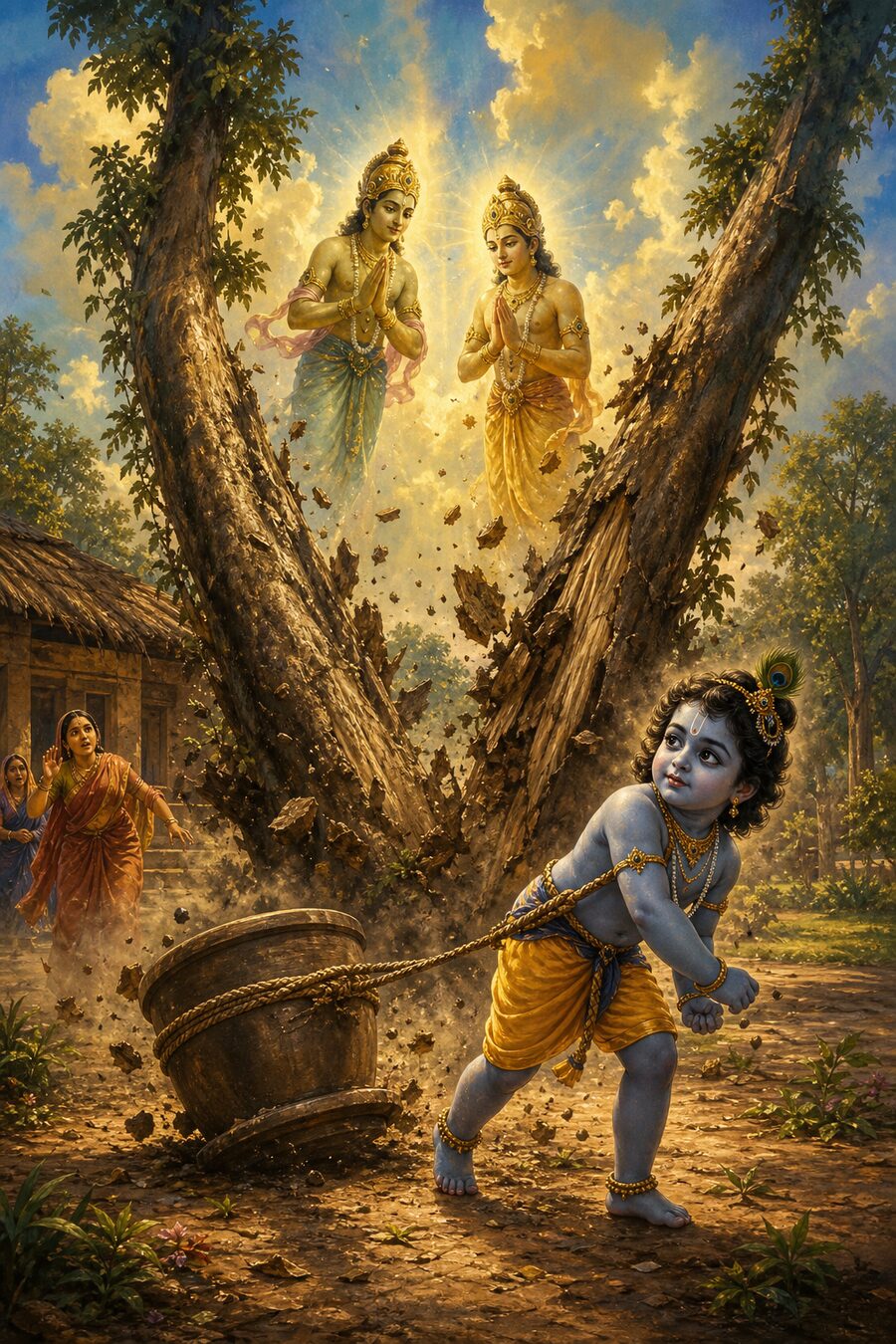
Bound to the mortar, the child set out. He crawled from the courtyard with the great wooden block scraping along behind him, and he made straight for the twin trees, as though he had known all along where they stood and had only been waiting for the rope. He worked the mortar into the narrow gap between the two trunks. It was broader than he was, and it wedged there, jammed fast against the roots.
The child did not stop. He leaned into the rope and pulled, one small tug, laughing as he did it, and the two ancient trees that had stood unmoved through age after age tore loose at the roots and came down together with a roar that shook the ground. The tellers say that as they fell, two shining beings rose out of the ruined trunks, restored to the forms they had worn long before, free at last. They folded their hands to the small child whose touch had ended their long punishment, and they went back to their own world.
And Gokul took the road to Vrindavan
That roar brought the whole of Gokul at a run. Milk-women carrying their jars down to the Yamuna had seen it first, and they came back weeping to Yashoda, crying that the two great trees had come down on her son, that he was laughing there between them like a calf roped under its mother, that he was alive as though he had been let go from the very mouth of death. Yashoda ran. When the villagers reached the spot they found two enormous trees toppled side by side, and seated between them, still roped to his mortar, the small child, not a scratch on him, smiling up at all of them. No one could piece together how it had happened.
Nanda reached his son and worked the rope loose from the mortar. He lifted the boy onto his lap and kept looking at him, and looking again, the way a man looks at someone who has come back from a country no one returns from. From that day the cowherds gave the child a new name. Because his mother had bound him at the belly with a cord, and because it was in that binding that he had pulled down the twin trees, they called him Damodara, the one with the rope around his middle. The name stayed with him.
The older cowherds stood among the fallen trunks and could not make sense of it. There had been no storm, no wind, no stroke of lightning, no rampage of elephants. Two of the tallest trees for miles had simply come out of the ground, and they had fallen so cleanly to either side that the child between them was untouched. The men began to count. First the she-demon Putana, who had come to nurse the infant with poison and had died for it. Then the heavy cart, splintered when the child was far too small to have touched it. Now the twin trees. Three times the ordinary rules had bent themselves around this one boy, and to the elders that made a pattern, and not a comfortable one. Whatever was gathering around the child, it had grown too large for this place, and the old wisdom held that signs like these did not point anywhere good. It was no longer fitting, they decided, to keep the settlement where it stood.
And so Gokul gathered itself up. The households loaded their carts, the cows and calves were brought in, and the whole settlement set out together for a fresh stretch of forest, green and unspoiled, where there would be grass for the cattle and quiet for the children. They were bound for Vrindavan, on the bank of the Yamuna, the forest where the loveliest and most daring of all his lilas were still waiting to begin.
Source: Harivamsha (the khila-parva of the Mahabharata), Vishnu Parva, chapters 52 to 53; critical edition (P. L. Vaidya, Bhandarkar Oriental Research Institute, Pune). Told as story, following the original sequence of events.