On this page
And the Voice That Flowed Like Nectar Slowly Fell Still
Even after the whole of Krishna’s life had passed before him, one question still worked in Janamejaya’s mind, the question every age asks of itself: what comes next? He was Parikshit’s son, the king at whose great snake sacrifice this entire history had been recited, and he had listened from the first word to the last. He had heard what already happened. What was still to come, and what shape would it wear? The age he wanted mapped was not a distant one. The Dvapara had closed behind Krishna’s departure from the earth, the Kali cycle was already gathering around him and everyone in the hall, and he wanted to know how far it would run and where it would leave humankind. So Vaishampayana, the disciple into whose keeping Vyasa had given the whole telling, gave him the one picture most tellings leave in shadow, and he gave it whole, sparing his listener nothing.
A Portrait of the Ages to Come
He set out the ages ahead, the long slow years in which dharma thins to a thread. Age after age, he said, the human span shortens, and as it shortens so does everything that grew inside it: patience, decency, the plain capacity for contentment. Greed swells to fill the empty room. Deceit swells with it. Vows are made and quietly unkept, joy comes to nothing while anger always finds its mark, and people come to follow a dharma worn down to a remnant, taking that remnant, whatever their own age happens to leave them, for the whole of it, since no one living has seen more.
The particulars are hard to sit with. A man’s entire life will finally fold into thirty years. Strength fails early, the color drains from the body, and new sicknesses arrive to fill the space that health leaves behind, fever preying on frames too worn to resist it. Kings stop protecting and only collect, taxing subjects they no longer defend, until the king behaves like a thief and the thief lives like a king, and thieves rob other thieves, which is the closest the age comes to justice. Everything once kept out of the market is carried into it: teachers sell their learning, farmers sell their grain, and there are those who sell their own bodies. Wealth alone is honored. The good are laughed at and the corrupt go uncensured. Every man turns merchant, sons carve up their fathers’ gifts, everyone begs and no one gives. Learning itself grows shallow and loud: without ever sitting at an elder’s feet, each man claims mastery of every branch of knowledge, and there is no one left who is not a poet. The household turns upside down, the son setting his father to work, the daughter-in-law giving orders to the mother-in-law, the student cutting his teacher with words. The seasons slip out of their order, the clouds hold back their rain, and open ground widens into waste. Driven by fear and hunger, whole families cross the Kaushiki river with their children on their shoulders and scatter, toward Anga and Kalinga, toward the skirts of the Himalaya and the shore of the salt sea, living on roots and fish and whatever else the forest yields, dressed in bark and deer-skin like hermits who never chose the hermit’s life. And they follow a shrunken faith taught by a shrunken teacher, because that is all their age has kept.
None of this is a happy picture. Yet folded inside it is a real consolation. This rise and fall belongs to the same great wheel of time from which the story itself first turned, and the wheel never stands still, even for a moment. The telling follows the turn all the way down and then up the other side: when life grows short, strength decays; failing strength brings disease; disease brings grief, and grief at last turns men inward; the inward turn wakes the remembrance of God, remembrance ripens back into virtue, and once people live the whole of dharma again, the Krita age simply comes back. As the moon fills through the bright fortnight and wears away through the dark, dharma swells in the Krita age and thins toward the Kali, and the time underneath is one and the same. Satya, Treta, Dvapara, and Kali are only its four measures. There is an old comparison for it. An heir who does not know there is gold under the dust in his own house believes himself poor, and calls the same lump gold only after it is washed clean. So the self, while the dust of maya lies over it, is mistaken for an ordinary creature, and the very same self, once that covering is gone, is known for pure awareness. Whenever dharma sinks to its lowest, that light comes down again, in one form or another.
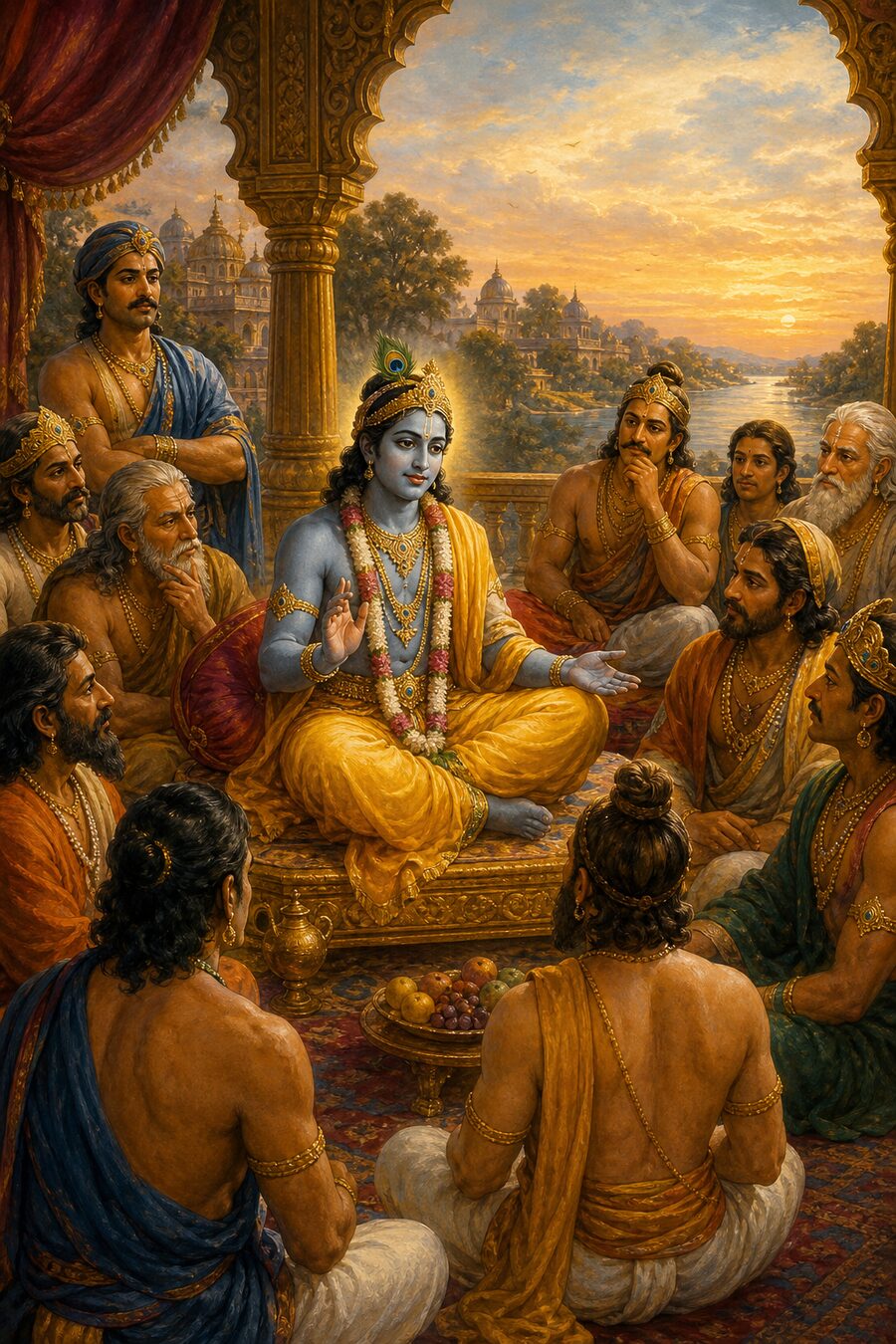
The Nectar Voice Comes to Rest
And then the voice, the one likened to the taste of nectar and to the cool light of the moon, filled its listeners’ ears a final time and slowly came to rest. He had told the vast chronicle, war and lineage and god-crowded battlefield alike, as easily as a man reads what is written on his own palm. Around the hall the telling left its mark. Some wept. Some sat without moving, gone inward. The thirst Janamejaya had carried since the very first words was answered at last. He had come to know the lineage Krishna stepped down into, its beginning and its inmost meaning both.
Here the Harivamsha rests. The story that began at the first nameless instant of creation has traveled the whole length of Krishna’s life, through the midnight birth in a guarded cell, through Gokul and its cattle-dust, through Mathura and Dwarka, to that far border of time where every telling finally arrives.
What Remains Behind
This khila-parva of the Mahabharata, an appendix that is a whole epic in its own right, closes here. Every large story leaves something behind it when the voice stops, the way warmth stays on in a room, and what the Harivamsha leaves is an assurance.
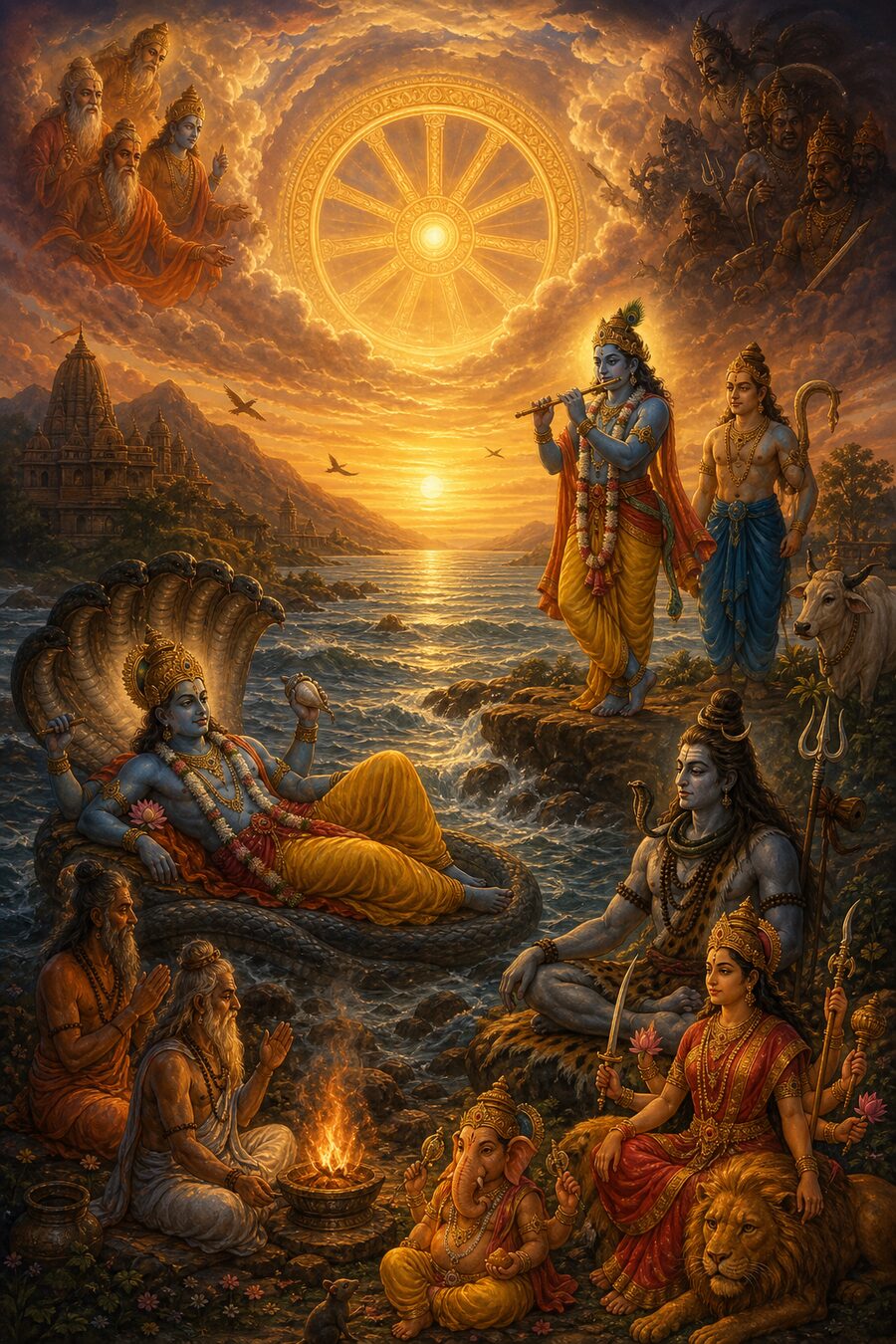
The assurance is this. Whenever the weight the earth carries grows past bearing, whenever adharma stands at its full height, whenever the earth herself, worn down to the shape of a cow, comes weeping to some threshold, that same light takes birth again, in one form or another, in some dark prison cell, on some midnight. It is the same cry that set this whole story moving, and it will set the story moving once more, as many times as the wheel requires, for the wheel and the light are older than any age they pass through. This is the gist of everything told here, and it is the blessing the telling leaves in your hands.
Source: Harivamsha (the khila-parva of the Mahabharata), Epilogue, chapters 114 to 118; critical edition (P. L. Vaidya, Bhandarkar Oriental Research Institute, Pune). Told as story, following the original sequence of events.