On this page
A Whirlwind That Carried Him Off, and a Cart That Overturned
Word of Putana’s death reached Mathura, and Kansa’s dread settled deeper. His most feared demoness had been sent against a suckling infant and had died in the attempt, and no amount of reasoning would make that fact sit still in his mind. So he kept loosing his agents on the cowherd country, each more monstrous than the one before it, certain that one of them, in the end, would catch the boy alone and finish what Putana could not.
The Black Whirlwind
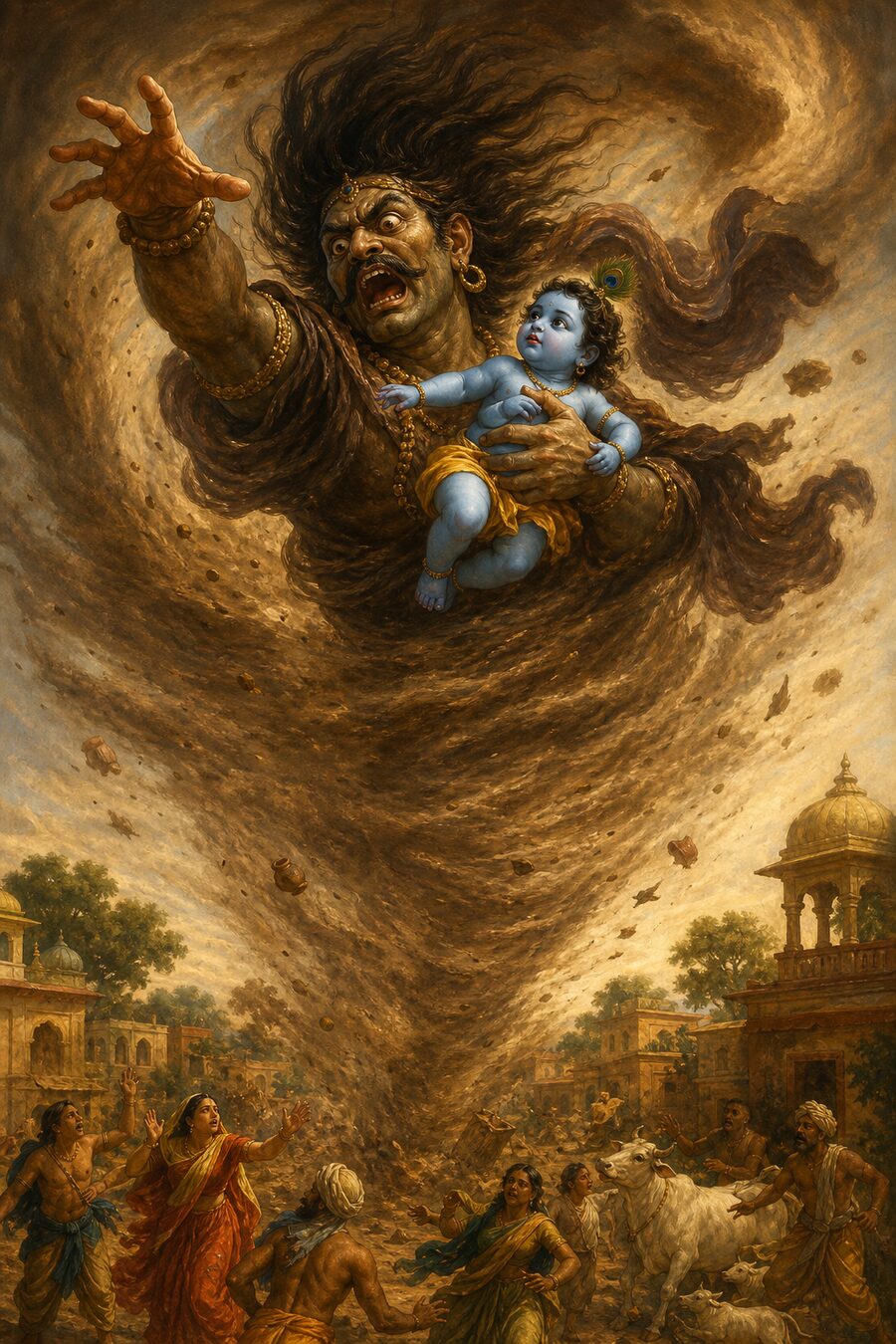
One morning Yashoda set her boy down in the courtyard and turned back to her work. Without warning the sky went dark. A wind came up out of nowhere and grew into a terror, Trinavarta, a spinning tower of dust and gale that closed over the whole of Gokul and swallowed the daylight. Grit filled the air until no one could hold their eyes open. When at last the wind fell and the dust began to settle, Yashoda looked to the spot where she had laid her son and found it empty. The storm had lifted him off the ground and carried him up into the sky.
Yashoda’s anguished cry rang through all of Gokul. High overhead, out of sight of the frightened village, something had begun to go wrong for the demon. The farther Trinavarta climbed, the heavier his small burden became, heavier and heavier, past anything a wind could carry, until the demon could neither rise any higher nor shake himself free of the child. Then the infant closed one hand around the demon’s throat and held on. Dragged down by a weight he could not understand and choked by that small grip, Trinavarta lost the sky and came down the whole long way to the earth. The fall broke the demon and nothing else. The boy was found sitting on the shattered chest, unhurt, and he was not even crying.
The Overturned Cart
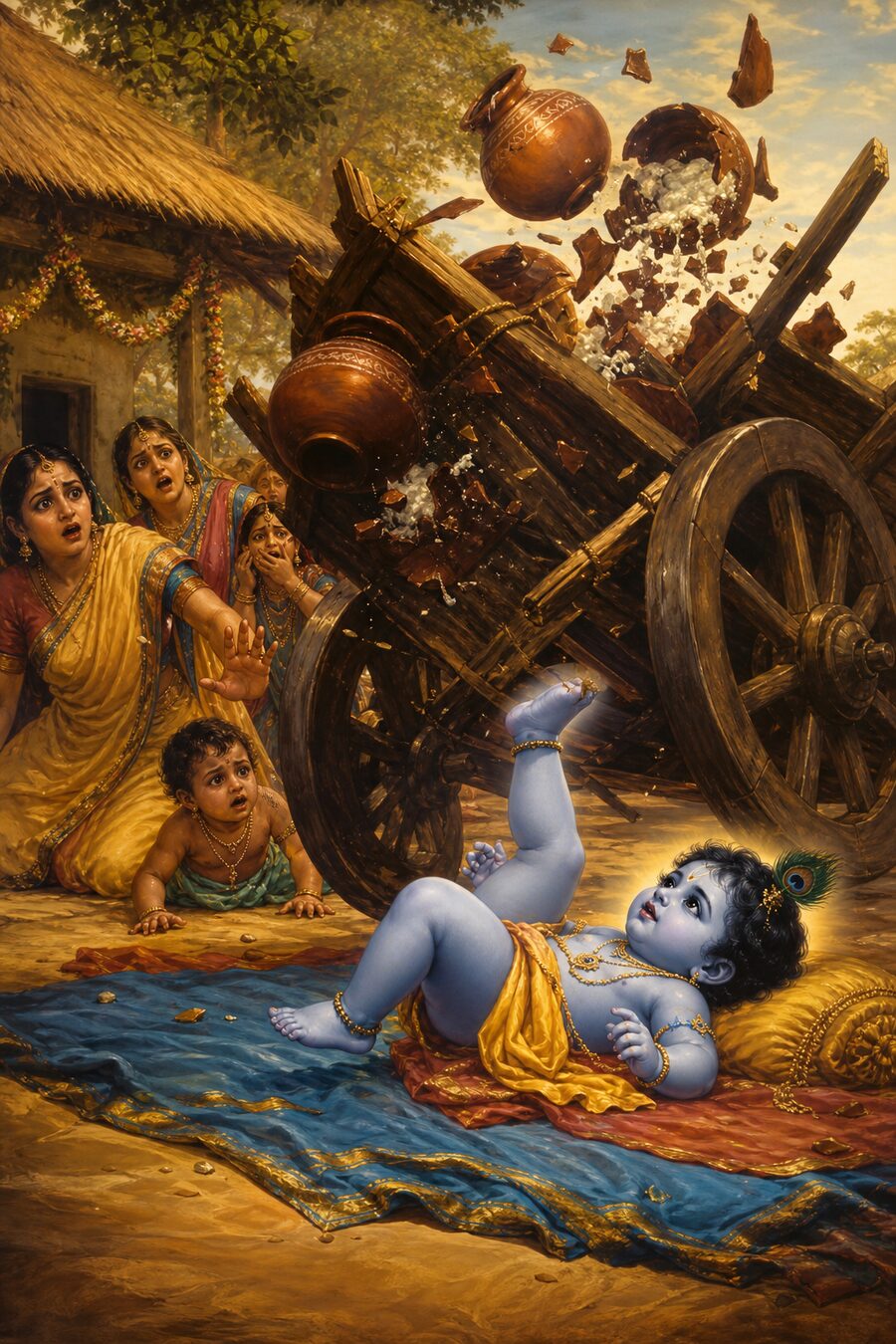
Another day the child lay sleeping in the shade beneath a heavy ox-cart in the yard, and Yashoda, easy in her mind, went down to the Yamuna to bathe and wash her clothes. While she was gone the boy woke hungry. He cried, and threw up his arms, and kicked his little legs in the air the way infants do, and one heel caught the underside of the cart. That was all it took. The cart went over. Then he rolled onto his belly, crawled a short way, and lay there crying for milk, as though nothing at all had happened behind him.
Yashoda came back from the river with her breasts full and aching, and fear already in her chest before she knew the reason for it. She found the cart lying on its side with no wind to account for it, snatched the boy up, and could make no sense of what she saw. What would his father say, she thought, when he heard the child had been left under a cart and the cart had gone over. What had possessed her to leave him and walk down to the river. Nanda came in soon after from the pasture, still in the silks he had worn out among the herd, and stopped short at the wreck. Both wheels stood up in the air. The axle was snapped, the pole broken, the pitcher smashed. He came running with his eyes streaming, asking again and again whether his son was alive, and only when he saw the boy at Yashoda’s breast did the breath come back into him. Then he asked the plain question: how does a standing cart tip itself over, with no bulls yoked to it and none fighting nearby.
The children who had been playing in the yard answered him. They had seen it, they said. The baby had kicked the cart over with his foot. Nanda stood amazed, pleased and frightened in the same breath, turning it over in his mind and finding no bottom to it. The grown cowherds, being ordinary men with ordinary sense, gave the children’s story no weight at all. They set the cart back on its wheels, lashed them tight, and went about the rest of their evening, and the thing stayed there behind them, explained by no one.
Play, and the Guarding Behind It
From the outside each of these was an ordinary sort of calamity: a freak wind that came and went, a cart that fell over in an empty yard. Yet a real danger had passed close and been turned back, and the wonders were piling up faster than the village could keep account of them. First Putana dead in the night with no mark of a killer on the child, then the wind, then the cart. The people of Gokul began to feel, without quite being able to say it, that something out of the common ran through this one small boy, and that wherever he was set down, some great power kept watch over the ground around him.
Kansa’s agents kept coming, one after another, and one after another they were wiped from the earth, and still Kansa had no thought of stopping. And the two brothers were growing now, old enough to range out with the cattle into the far forests, where dangers larger than any wind or cart were waiting for them.
Source: Harivamsha (the khila-parva of the Mahabharata), Vishnu Parva, chapters 51 to 52; critical edition (P. L. Vaidya, Bhandarkar Oriental Research Institute, Pune). Told as story, following the original sequence of events.