On this page
The Woman Who Could Not Bear Her Husband’s Blaze
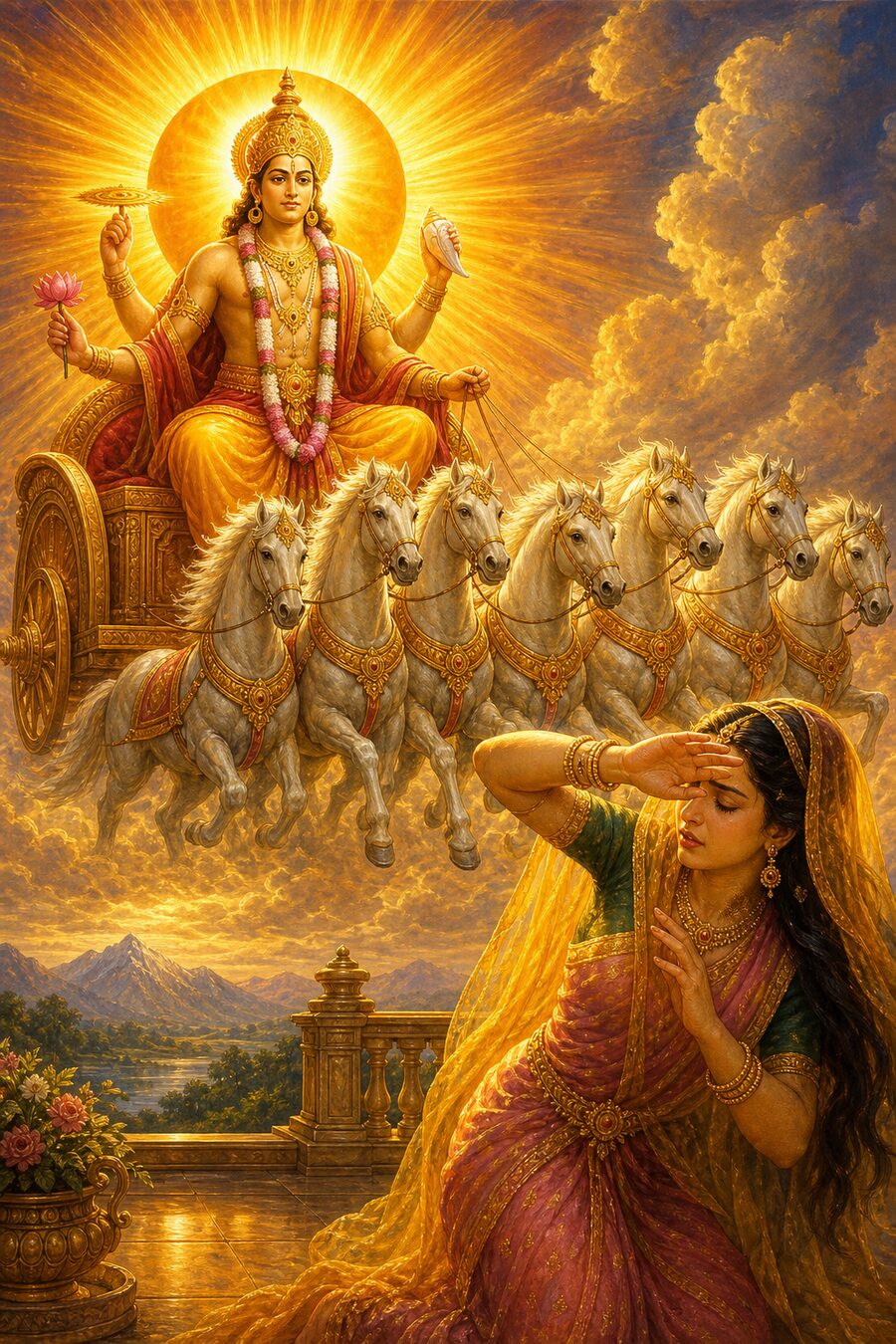
Now the story arrives at the house of the Sun, and it opens with an ache that is entirely human. Vivasvan, whom the gods called Martanda, was the son of the sage Kashyapa and of Aditi, daughter of Daksha. There was an old reason for that name. While Aditi carried him, a curse had condemned the child to be stillborn, and Kashyapa drew him back to life by the force of his austerity, declaring over the frightened mother that the egg was not dead; so the boy came into the world already marked by death, carrying a name that means exactly that, and the light he grew into bore down on all three worlds without softening. He had married Sanjna, a woman of rare beauty and rarer discipline, no ordinary bride but one whose austerities few women on this earth could match. She loved him. What she could not do was live inside the full weight of his blaze. His rays scorched her until her own beauty dimmed beneath them, and each time she tried to hold her eyes on his burning form, she had to look away.
For a long while she carried it, the strange suffocation of finding unbearable the very heat of the one you love, of wanting to draw close and being driven back by the drawing close itself. In those years she bore him three children, and even they could not hold her in that house. At last she settled on a way out. There was defeat in it, and there was daring.
A Shadow, to Keep the House
By then Sanjna had given the Sun three children: Vaivasvata Manu, who would be the Manu of our own age, and the twins Yama and Yamuna. She could not carry them into the heat she was fleeing, and she would not leave the house untended. So she reached into her own shadow and drew out of it a second woman, a double so exact that no eye could have told them apart. The shadow rose at once, folded her hands, and asked only to be commanded. This shadow-born woman is remembered as Chhaya. Sanjna, who knew the arts of illusion, set her in her own place and taught her carefully: live here as me, keep this house, watch over my children as though they were yours, and never let the Sun learn that you are not his wife.
Chhaya bowed and agreed, with one honest reservation. She would hold the secret, she said, for as long as the Sun did not seize her by the hair or lay a curse on her; pressed that far, she would not be able to keep silent. Sanjna accepted the condition and left. She went first to her father, Tvashtri, the celestial craftsman who builds the chariots of the gods, and stood before him in shame, and he heard her out, chided her again and again, and sent her back to her husband. She did not go back. Instead she hid her beauty in the body of a mare and traveled to Uttarakuru, the far northern country, and there she grazed the green plains and gave herself to hard austerity, looking for the peace her own home had refused her.
The strange thing is how long it held. For years the Sun never once suspected that the woman at his side was a shadow standing in his wife’s place. He lived beside her, and in time he fathered two more sons on her: Savarni, who resembled the first Manu so closely that the likeness itself helped the disguise hold, and Shani, slow and grave. So near to her, and still the secret kept, season after season, under the gaze of the one being from whom nothing in the three worlds is supposed to stay hidden. There is a quiet truth folded into that. We often fail to truly see even the people closest to us, and simply take it on faith that everything is as it appears.
The Secret Breaks, and the Blaze Is Ground Down
Chhaya wore Sanjna’s face to the last detail, and still a mother’s love was the one thing she could not counterfeit. Slowly she began to favor her own boys over the three children Sanjna had left in her care, and the older children felt the cold of it. Manu, the eldest, let it pass. Yama could not. Stung one day past his patience, the boy who would one day weigh the deeds of every soul that dies raised his foot against the woman he believed was his mother. He never brought it down, but the threat alone was enough. Chhaya, furious, cursed him: that foot of yours will fall away from you.
The curse terrified Yama, and he carried it straight to his father. A true mother, he pleaded, could never wish such a thing on her son; a son may fail at being a son, but a mother never fails at being a mother. She has loved the youngest and slighted the rest of us, and though I raised my foot in anger it never touched her, so let this be lifted from me. The Sun looked at his son, truthful and shaken, and knew that something was badly wrong; a boy like this one does not come to anger without a mighty cause, and no mother curses her own child this way. He could not simply unsay the words, for a mother’s word, once spoken, has to land somewhere. So he bent it instead. Worms would take a little flesh from that foot, he ruled, and carry it down to the earth, and Yama himself would be spared and would rise. The curse would keep its letter, and the son would live.
Then the Sun turned to the woman he still took for his wife. Why, he asked her, do you keep favoring one child over the others? She had no answer, and her silence told him more than any answer could. He drew his mind inward, and by the sight that austerity gives him he saw the whole of it. Angry now, he reached to curse the impostor and caught her by the hair, and at that touch the seal on her promise broke, exactly as she had warned that it would. Chhaya told him everything: the real Sanjna had fled his heat years ago and was hiding somewhere far in the north.
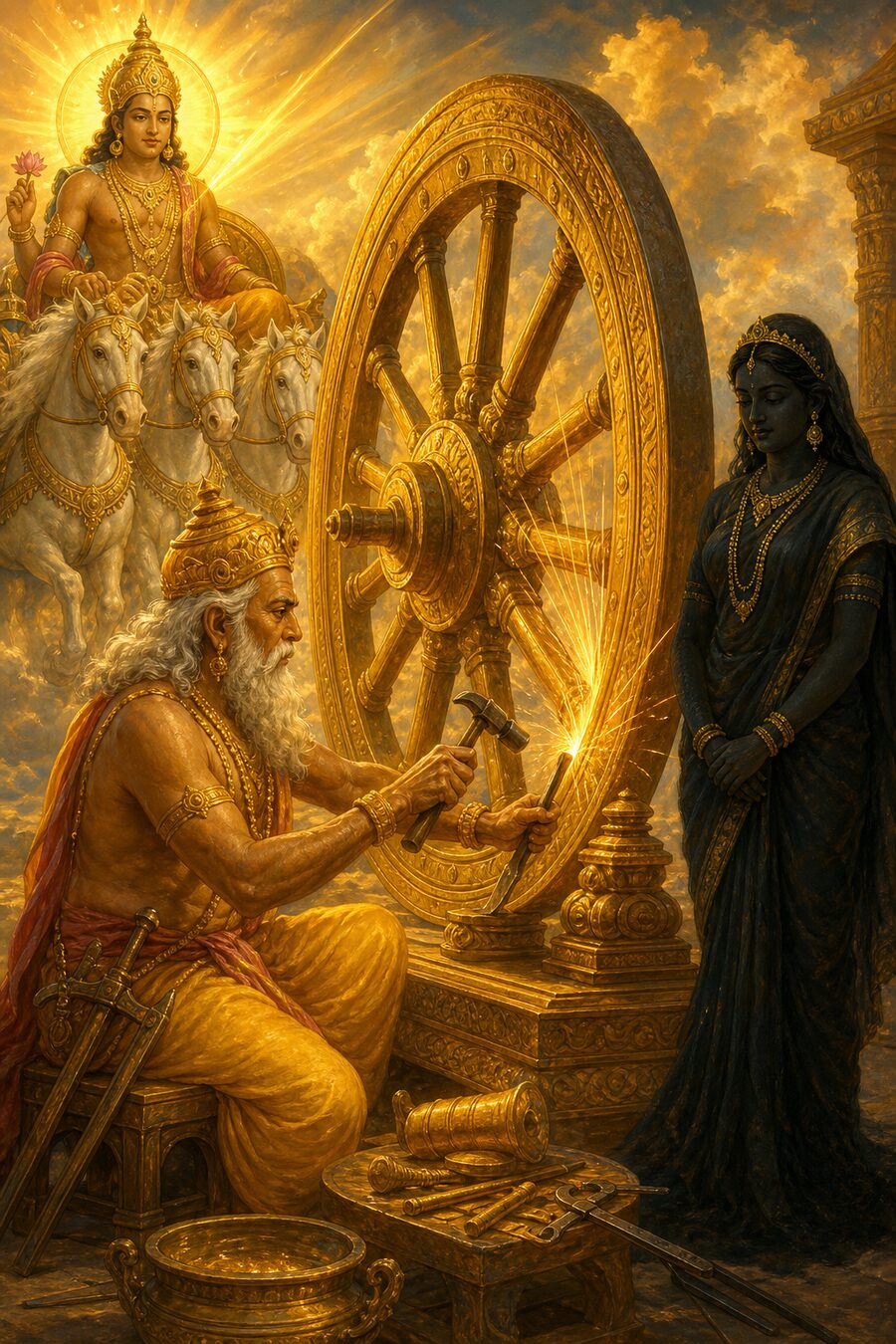
The Sun went to Tvashtri, blazing with a fury that could have burned the craftsman where he stood, and Tvashtri met it by praising him first and then giving him a plain diagnosis. Your form is too fierce to look upon, he told him; that is why your wife wastes away in a distant forest, living on leaves as a mare, her hair grown into matted locks, worn thin by penance, crushed the way a lotus is crushed under an elephant’s tread. Let me take the excess off you. The Sun agreed. Tvashtri set him on his lathe and pared the surplus brilliance from him the way a turner shaves a rim of wood, until what was left was still radiant and now bearable to stand beside, and by every account more beautiful than before. From that day the face of the Sun has carried a reddish cast, the mark of the cut. And the shavings did not go to waste. Out of the pared-off fire Tvashtri forged the discus of Vishnu, the weapon that is never turned aside against the demons, and other great arms of the gods besides.
Gentled and made beautiful, the Sun took the form of a horse and rode north to Uttarakuru to find her. The mare grazing there was fearless and untouchable, guarded by the power of her own penance, and when the stranger-horse approached she did not know him and turned away; even disguised, even after everything, she kept faith with the husband she thought she was refusing him for. From that union the twin Ashvins were born, the horsemen who would become the physicians of the gods. Then the Sun let his true form show. Sanjna looked at her husband and saw a radiance she could finally stand beside, a light that had consented to be less so that she could come near, and the long ache of that house came to rest. She came home.
In the end the whole of that strange household found its station. Yama, sobered by what his anger had cost him, ruled his people so justly that he became Dharmaraja, the king of dharma, and was given charge of the ancestral dead. Yamuna, his twin, became the river of that name that still carries her purity through the world, the same dark water on whose banks this story will one day set Krishna’s childhood. The Ashvins took their place as the healers of heaven. Nor were Chhaya’s sons forgotten: Shani rose to become the slow, cold planet that every world watches with respect, and Savarni went to Mount Meru to sit out a long penance, where he sits even now, for he is the Manu appointed to an age still to come.
And the Solar Line Moved Forward
And from Vaivasvata Manu, the eldest of that house, the line of the present age went forward, the Suryavansha, the solar dynasty whose roots run so deep that a king like Rama will one day be born inside it. Manu’s own eldest son was Ikshvaku, who took the heartland of the earth for his portion and marked it with the stakes of his fire-rites, and from Ikshvaku descended the house of Ayodhya, a name that would come to stand for dharma itself.
Manu’s other sons carried the line outward. From his nine sons royal houses spread into every corner of the earth, as if a single seed had thrown up a hundred trees, and with every tree came some story, some austerity, some fall, some boon. And he had one child more, stranger than the rest: Ila, who rose full-grown out of a great fire-rite, clad in celestial cloth and celestial armor, and who lived as a woman and as a man by turns and went, in the male form, by the name Sudyumna. Through Ila’s son Pururava, fathered by Budha of the Moon’s own line, a second great dynasty took its first breath, the lunar line, the line that will in time come down to Yadu. It is toward Yadu that the tale now turns, and toward a jewel that is about to cast the first shadow across the brow of Krishna.
Source: Harivamsha (the khila-parva of the Mahabharata), Harivamsha Parva, chapters 8 to 9; critical edition (P. L. Vaidya, Bhandarkar Oriental Research Institute, Pune). Told as story, following the original sequence of events.