On this page
The First Silence, and the First Sound
Janamejaya had heard the whole of the Mahabharata. Through the long days of his serpent sacrifice, Vaishampayana, the disciple of Vyasa himself, had unrolled it all for the young king: the rise of the Kurus and their ruin, the eighteen days of the great war, the deeds of Krishna that ran like a bright thread through all of it. And still one corner of him stayed empty. In that vast telling the Vrishni and Andhaka warriors had crossed the field again and again, named and praised, and yet the house they came from, the Yadu line into which Vasudeva’s son Krishna was himself born, had never been unrolled from its source. He folded his hands toward Vaishampayana. Teacher, he said, you have shown me the Kurus from their first breath, and the Pandavas and the Vrishnis share one blood, and you watched all of it with your own eyes. Now take me into that other family whole. Begin at the very beginning, with the first Patriarch, reaching back through the creations that came before, and leave out no name and no deed.
The wish pleased Vaishampayana, because it was the right wish. Whoever keeps this lineage close, he said, whoever listens to it with a steady heart, holds his own line together, watches his family multiply, and is spoken of well in the world of the gods. But a family like this one cannot be entered from its doorstep, king. The thread has to be lifted from very far back, from before there was a single name, or a shape, or even time to hold them apart. And with that he carried the story out of the palaces and the battlefields altogether, back to the first moment of all, when nothing had yet begun.
The Unmanifest, and the World That Broke From It
In the beginning, Vaishampayana said, there was only what the seers call the Unmanifest: one cause, formless and without end, the same in the things that exist and the things that do not, neither being nor absence, neither day nor night. No word can hold it, because words had not yet been made. Call it the deep silence out of which the first sound would one day rise, the blank cloth on which a whole world was still to be painted, something far too vast to drift across any sky as a passing thought, for there was no sky yet for anything to cross.
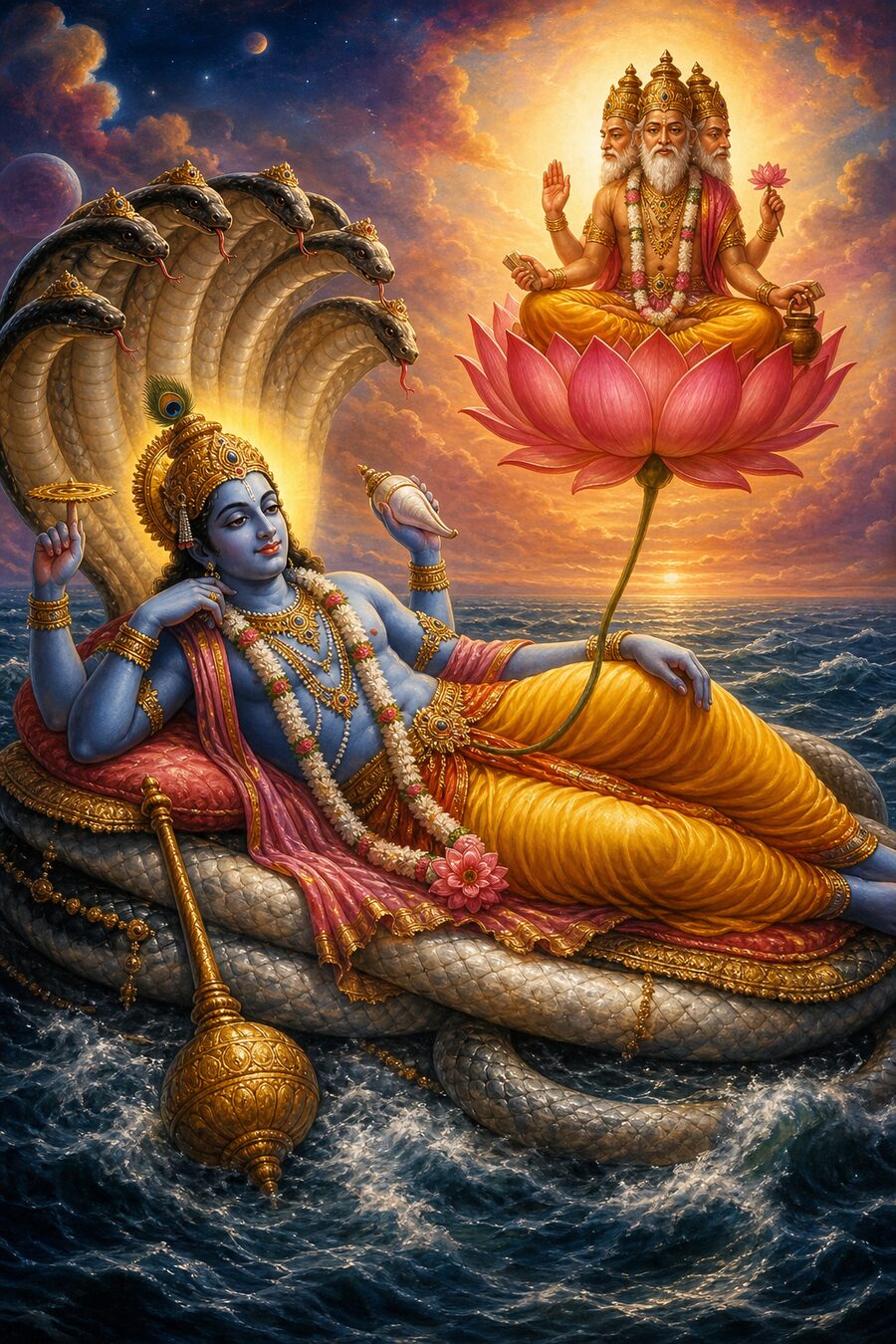
Out of that beginningless deep, primal nature and the spirit stirred, Prakriti and Purusha, and the universe began to open layer on layer. Brahma rose from it, self-born and past all measure. First he laid down the waters and set a seed in them, and the waters carry his oldest name inside them still: they are Nara, the children of Nara, and because he made them his first resting place he is called Narayana, the one who moves on the waters. Whenever that name is spoken in a prayer, it is this moment the name remembers. In the waters a single egg formed and slowly took the color of gold, Hiranyagarbha, the golden womb, and from that egg Brahma came forth of his own accord. When he had lived inside it through uncountable years he broke it cleanly in two, and the halves became the sky above and the earth below. Between them he opened the empty reach of space, set the floating earth in the water, and fixed the ten directions. Then, meaning to bring forth the lords of creation, he made time itself, and mind, and speech, and the three currents that would drive every creature that came after him: desire, anger, and longing.
From Brahma unfolded mahat, the great cosmic mind; from mahat came ahamkara, the first sense of I am; from that sense the five subtle elements, ether and air and fire and water and earth; from the elements the solid world; and from the world the four kinds of living thing, those born from a womb, those from an egg, those from heat and damp, and those that break upward out of the ground. He drew seven great seers from his own mind, Marichi, Atri, Angiras, Pulastya, Pulaha, Kratu, and Vashistha, seven names that would father the families of gods and sages and stand quietly behind half the stories still to come, and from his anger Rudra, and the ageless Sanatkumara, elder to everything born before him. He brought out the three Vedas for the fire-rites, so that every offering would have words to travel on, then the gods from his mouth, the fathers of old from his breast, human beings, and the asuras behind them. This is the order that repeats at the dawn of every kalpa, every full turn of the world, as though someone kept striking up the same melody, and each time a fresh world rose to dance to it.
Daksha, and the Thousand Streams of Creation
Brahma’s mind-born sons began the work, but a creation shaped by thought alone would not multiply, and so the true labor of peopling the world passed to Daksha, who carried in him a portion of the Moon’s own splendor. Daksha too made his first creatures by pure thought, thousands of radiant sons, and lost every one of them: the wandering sage Narada asked those boys how they meant to fill a world they had never once measured, and they walked away to the ends of creation to measure it first, and like rivers gone into the ocean they never came back. So Daksha turned to the joining of male and female and fathered daughters without number. These he gave out across the whole of creation as wives: ten to Dharma, thirteen to the sage Kashyapa, and twenty-seven to Soma the Moon, and those twenty-seven became the nakshatras, the lunar mansions that ride the night sky, the same twenty-seven houses the Moon still visits on his slow round, one for each night of his month. Through his daughters every quarter of the world filled at once, with gods and asuras, gandharvas and nagas, yakshas, beasts, birds, and men. Shatarupa belonged to an older making still: Brahma had shaped her himself, by the force of his own discipline, born of no woman, and she became the wife of Svayambhuva Manu, the first man, from whom the human line came down. And through all of it two great rivers of kings began to run, the line of the Sun, carried by Vivasvat and his son Vaivasvata Manu, and the line of the Moon, carried by Soma.
To Soma the Moon, Brahma gave a rare charge: lordship over the Brahmins, over the healing herbs, over the planets and the nakshatras, over the fire-rites and the long austerities. Soma held a Rajasuya, the great royal sacrifice by which a sovereign is set above all other kings, and gave away cattle by the ten million, with Atri and Bhrigu and Brahma himself standing as its priests, and he came out of it wrapped in a splendor almost too heavy to carry. The splendor swelled his pride until he lost hold of himself. In its glare he carried off Tara, the wife of Brihaspati, teacher of the gods, and would not give her back, though the gods pleaded and the rishis pleaded, and heaven split into open war over her, Shukra, teacher of the asuras, standing at the Moon’s side, and Rudra himself standing with Brihaspati, the great bow Ajagava in his hands, until Brahma stepped in between them and returned her. Out of that one trespass a son was born, Budha, a boy so beautiful that the gods crowded around demanding to know which father he belonged to, and from Budha the lunar river ran on, through Pururava and a long descent of kings, until far downstream, in that same current, Yadu would be born. The Moon paid in his own body all the same: for that arrogance a wasting crept into him and thinned his light, and though his father Atri washed the sin from him and filled him bright again, he had learned what a splendor too heavy to carry finally costs.
And the Wheel of Time Kept Turning
Having brought the story this far, Vaishampayana showed Janamejaya the thing that turns silently behind every other thing: the great wheel of time. Time is counted, he said, from the nimesha, the span of one blink. Five blinks make a kashtha, thirty kashthas a kala, thirty kalas a muhurta, thirty muhurtas one day and one night of ours, and the days climb into fortnights and months, until a single month of ours is one day and one night for the fathers of old. The dark half of the month is their daytime, and that is why the water and the offerings for the ancestors are poured in the dark fortnight, when the dead are awake to receive them. A single year of ours is one day and one night for the gods, the sun’s northern course their day, its southern course their night. The four ages fall away in fixed proportion, the Krita age longest, then Treta, then Dvapara, then Kali, four to three to two to one, each age carrying its own long dusk and dawn folded around it, and together they make one great age of twelve thousand years of the gods. Seventy-one of those great ages fill the reign of a single Manu, one manvantara, and fourteen Manus reign in turn across a single day of Brahma: Svayambhuva first, then Svarochisha, Uttama, Tamasa, Raivata, and Chakshusha, and now the seventh, Vaivasvata, under whom this present world stands, with the Savarnis and the last Manus still waiting their turn to come.
When the fourteenth Manu has passed, Brahma’s day is spent, and his night comes down, a night as long as the day itself, a thousand great ages of dark. The worlds melt into a single ocean, and every living thing sleeps through that night inside the body of Narayana, the whole of creation folded away the way a full-grown banyan sleeps inside one seed, until Brahma wakes and sets it all moving again, with the same memory and the same order, only the arrangement made new. In that immense current float all the dynasties whose stories are still ahead, small as bubbles on the water, and yet inside each bubble a whole life, a whole world.
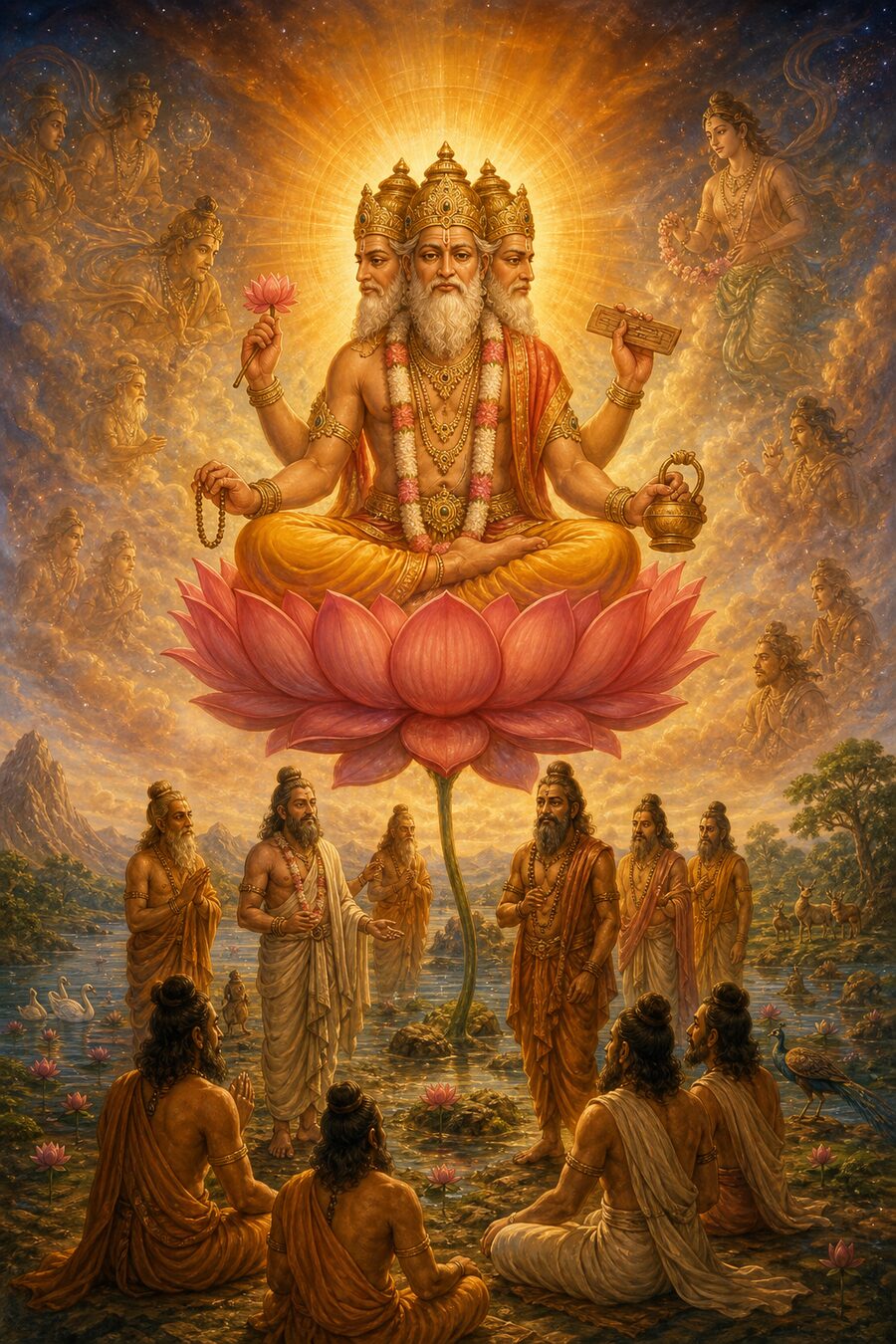
The vast scaffolding of creation now stood complete, its floors laid, its great wheel turning. Within it the first great story was ready to rise: the story of a king who made himself a byword for everything against dharma, who silenced the Vedas and the fire-rites and ordered the world to lay its worship at his own feet, and of another king who was drawn out of that same ruined body as dharma itself, the first king the earth would ever crown, and the one whose name she would take for her own.
Source: Harivamsha (the khila-parva of the Mahabharata), Harivamsha Parva, chapters 1 to 4; critical edition (P. L. Vaidya, Bhandarkar Oriental Research Institute, Pune). Told as story, following the original sequence of events.