On this page
The Tree of Heaven That Came Down into a Courtyard of Dwarka
Naraka was dead, and the hoard he had wrung out of three worlds was already moving toward Dwarka. It was a treasury richer than anything in the houses of Kuvera or Yama, richer than anything the keepers of it had seen even in Indra’s halls: diamonds, pearls, corals, sapphires, and emeralds past counting, a lion-throne that burned like living fire, a bed that shone like the moon, twenty thousand war-elephants with twice as many cows behind them, eight hundred thousand horses of the finest breeds, and marvels carried off from Varuna’s own realm, a golden fountain of a thousand streams and an umbrella that rained gold. Krishna sent it all on to the city of the Yadavas. The daughters of the Gandharvas and the Asuras whom the demon had shut away in his mountain fortress he set free, and sent them home to Dwarka under guard. One thing alone he would not trust to another hand. Among everything Naraka had stolen was a pair of earrings that belonged to Aditi, the mother of the gods, torn from her while the whole of heaven looked on and could not stop him. Those Krishna meant to carry up himself.
Heaven held Krishna’s own kin. Aditi had borne two sons. The elder had risen to become Indra, king of the celestials, the god who carries the thunderbolt. The younger had come down into the mortal world as Krishna, though the gods still knew him by an older name, Upendra, the one who stands at Indra’s side, a name he had carried since the distant age when Vishnu chose birth as Aditi’s own child and measured back the three worlds in three strides. So the flight up was a homecoming, to a mother and to an elder brother.
Garuda climbed with Krishna and Satyabhama on his back, past the tracks of the sun and the moon, past the shining habitations of the Vishwadevas and the Sadhyas, of the Maruts and the twin Ashvins, up to Sumeru and the city of the king of heaven. Indra came out to welcome them, and the welcome was a brother’s, glad and unguarded. Krishna set the recovered earrings in his brother’s hands, and Shachi, Indra’s queen, the daughter of Puloma, took Satyabhama by the hand and received her as her own.
Then the two brothers went together, with their wives, to the house of their mother. Aditi sat deep in tapas, austerity, ringed by those who had come to worship her. It was Indra who laid the earrings before her and told her everything his younger brother had done, how he had gone down into Naraka’s fortress and brought her stolen ornaments back to her, and there was pride in the telling. Aditi drew both her sons onto her lap, the king of heaven on one knee and the lord of the worlds on the other, and blessed them. To Krishna she said that as the king of gods was honored in every world, so he would stay beyond the reach of every creature alive. Then Shachi and Satyabhama bowed at her feet, and to Satyabhama the mother of the gods gave a gift no woman of earth had ever been given. As long as Krishna wore his human form, she said, old age would never come near this wife of his. Satyabhama would stay young and fortunate through all those years, and her body would carry a fragrance that belonged to heaven.
Indra honored his brother with jewels in his turn, and with his leave Krishna rode out on Garuda through the gardens of heaven, Satyabhama beside him and the whole host of celestials singing his praise. In Indra’s own pleasure garden, Nandana, he came upon it. The Parijata. No ordinary tree. Its flowers never faded, and it put out fresh blossom every day of the year, so that no morning of heaven ever opened without it. Its fragrance carried far past the garden walls, and it was said that whoever drew near it recovered the memory of his own former births, life upon life, all the way back to the beginning. Satyabhama, who now carried a fragrance of heaven in her own body, stood before a fragrance older still, and could not turn away from it. She wanted this tree standing in her own courtyard in Dwarka.
The Tree Heaven Meant to Keep
Gods stood watch over the Parijata. It was the pride of Indra’s garden, and it was never meant to leave the sky. Krishna knew all of that and reached for the tree anyway. He tore it up by the roots, whole, with the soil of heaven still clinging to it, and set it on Garuda’s head, and the great bird carried the weight of a tree of heaven as easily as he carried its lord.
There was something strange in that hour. The one with every claim to the tree was the king of the gods himself, and the one carrying it off was his own younger brother, the avatar who had come down to guard dharma. Word of the deed reached Indra after the tree was already gone. He let it pass without a word of blame. All he said was that Krishna never failed to carry off whatever he set his hand to. Spoken by the king of the gods about his own younger brother, it sounded like praise.
So the celestials sang him on his way, the seven great rishis raised their hymns, and the apsaras gathered at the garden’s edge to watch Satyabhama go, one woman of earth carrying home a piece of their sky. Krishna turned toward Dwarka with the Parijata riding on Garuda’s head. The long miles of sky folded short beneath those wings, and the city of the Yadavas rose into view below.
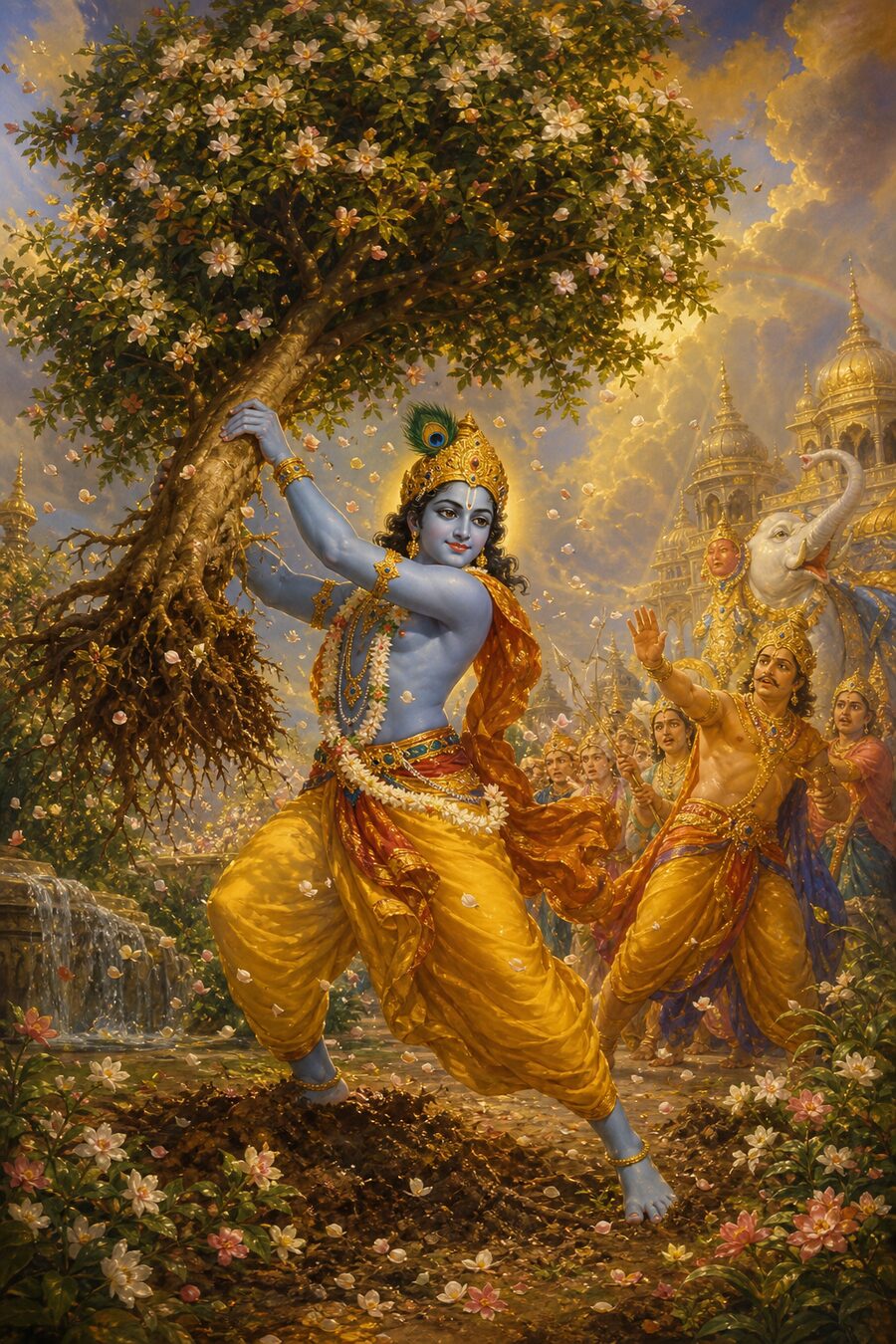
Heaven in a Courtyard
The Parijata was planted in Satyabhama’s courtyard in Dwarka, and it took to the soil of earth as though it had been waiting for it. They say its shade fell well past her walls, and its fragrance drifted out across the whole city, down the streets and into the fishermen’s lanes and the king’s halls alike, until there was hardly a heart in Dwarka that did not soften a little in the sweetness of it. A queen had asked for the tree; a whole city received it. What had been the pride of heaven now stood in flower in an earthly courtyard.
This belongs to the long thread of Krishna’s lila, his divine play, in which the distance between heaven and earth suddenly wears thin, as though both worlds had been folded into a single courtyard. Where Krishna is, even heaven leans down and comes to him.
The Full Days of Dwarka
Across these Dwarka years Krishna’s life ran in many currents at once: many queens, many children, the tangled work of statecraft, a whole world of kinsmen and friends. This was the season when the avatar was also a husband, also a king, also a friend, and he carried every one of those lives at the same time.
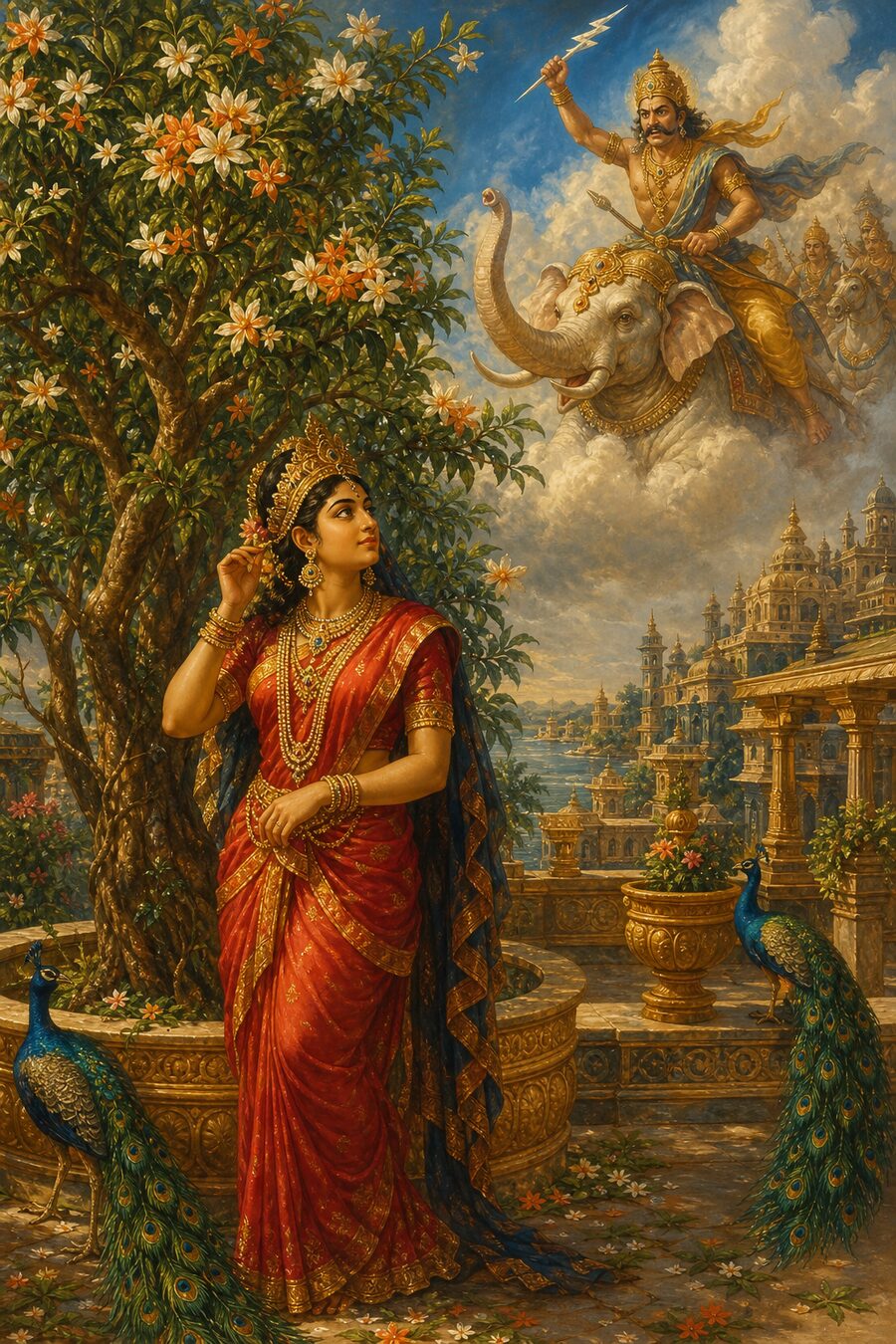
Through all those crowded days one thread held firm: strength raised only to protect, and a deep restraint that stayed even after the victory was won. And now the story bends toward its last great battle, a war set off by nothing more than a dream of love that drew in Krishna’s own grandson, with no kingdom and no treasure anywhere at stake, a war in which Mahadeva himself takes the field on the far side.
Source: Harivamsha (the khila-parva of the Mahabharata), Vishnu Parva, chapters 96 to 104; critical edition (P. L. Vaidya, Bhandarkar Oriental Research Institute, Pune). Told as story, following the original sequence of events.