On this page
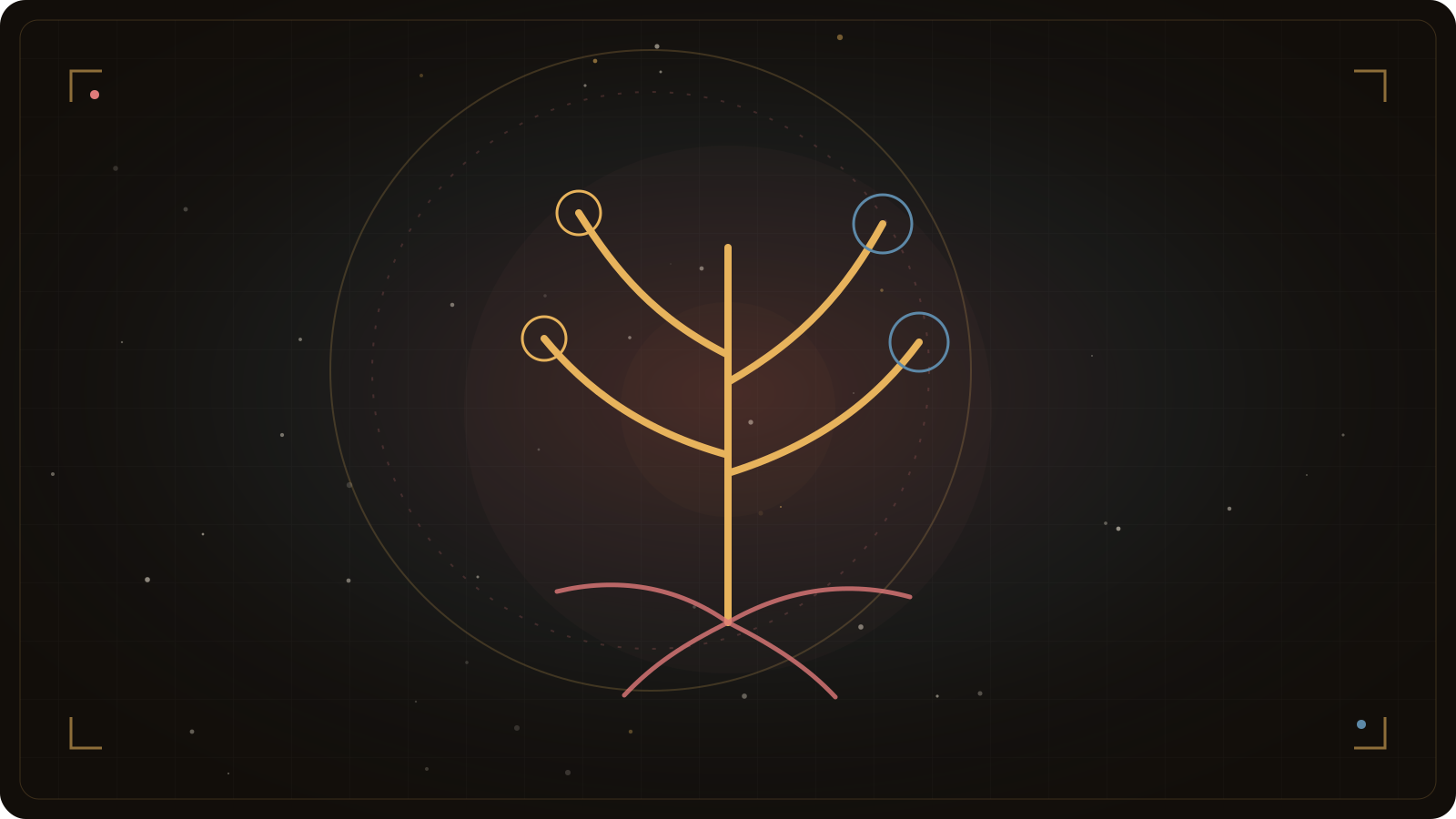
The gist: the eighth chapter opens with a volley of questions from Arjuna and comes to rest on one deep law, that whatever a person remembers in the final moment becomes the direction of the journey that follows. Folded into this are the imperishable akshara, the chanting of Om, the two unmanifests that lie behind all that appears, and the two paths of departure, one of which brings the traveler back and one of which never does.
Moments ago Krishna had let a few words fall at the very edge of his speech, and Arjuna’s mind had snagged on them. Now Arjuna asks him to open them up. He folds his hands and says, Purushottama, what is that Brahman? What goes by the name adhyatma? What does karma mean? What should be understood by adhibhuta, and what by adhidaiva? Who is the adhiyajna, and how does he dwell inside this body? And the deepest question of all: at the hour of departure, when a man must let the body go, how are you to be known by those who have steadied their minds?
Krishna answers each in turn. That which is supreme and imperishable, he says, is Brahman. One’s own self, the living soul seated within each being, is what goes by the name adhyatma. The creative outpouring by which beings come into existence and are carried forward, that act of release, is karma. All perishable things make up the adhibhuta. The radiant cosmic Person, Brahma the creator, first-born and lord of all the gods, is the adhidaiva. And here inside this very body it is we ourselves, seated as the silent witness within, who are the adhiyajna.
Remembrance at the final hour
With that said, Krishna comes to the law that is the very breath of this whole chapter. Kaunteya, he says, whatever a man carries in his mind as he lets go of the body at the end, that alone he moves toward next.
The one who departs from this body remembering us alone in the final moment reaches our very nature; in this there is no doubt. (Gita 8.5)
Whatever state a person remembers while leaving the body at the last, Kaunteya, that alone is what they reach, because their whole life long they had been steeped in that very state. (Gita 8.6)
Arjuna gauges the depth of this. The final moment is a sum, the total of a whole life’s thinking; nothing about it drops out of the sky. Whatever a person spent a lifetime remembering will rise on its own and stand before them at the last breath. This is why Krishna presses him. Remember us at every hour, he says, and fight this battle that is yours to fight. Keep your mind and your reason fixed on us, and you will come to us, past any shadow of doubt.
One syllable, Om
Then Krishna points to the practice by which the mind holds steady all the way to the end. The one who trains the mind through steady meditation and lets it wander toward nothing else, he says, who draws the senses inward, gathers the mind in the heart, and by the power of yoga lifts the life-breath to the crown of the head, and who leaves the body sounding that one imperishable syllable Om while remembering us, reaches the supreme goal. This Om is the single indestructible syllable that is Brahman itself, the seed-sound in which the whole of the Veda lies gathered.
Krishna also paints the supreme Person on whom the mind is to be fixed. He is all-knowing and ancient, the ruler of all, subtler than the atom, the sustainer of everything, a form past all imagining, luminous as the sun on the far side of every darkness. Whoever holds that Person in mind with love and unswerving bhakti (devotion), settling the life-breath between the brows by the strength of yoga at the very hour of departure, travels all the way to that radiant, supreme Person.
And he offers an assurance. For the one who remembers us without a break, with a mind that admits nothing else, for that ever-yoked yogi we are easy to reach. Such a devotee needs no elaborate contriving to arrive.
Krishna carries the promise one step further. The realized devotees who reach Krishna, having come to the highest perfection, are not born again into this house of sorrow that keeps changing its shape and never lasts.
Brahma’s day and night
Krishna sets this against the reach of the worlds themselves. Every world, he says, from Brahma’s own realm at the summit of creation down to the lowest, rises and falls in its season and sends its dwellers back to birth. Only the one who reaches us comes back no more.
Then Krishna turns to the vast wheel of time, against which a human life shrinks to a single instant. One day of Brahma, he says, stretches across a thousand cycles of the four yugas, a span the seers name a kalpa, and his night, the great dissolution, runs just as long. When that day dawns, all beings pour out of the unmanifest into form, and when the night comes down, the same beings sink back into that unmanifest. So it turns, again and again, with no say of their own for the beings caught in it, an unstopping cycle of birth and dissolution.
But Krishna does not stop there. Beyond all this appearing and disappearing, he says, stands another unmanifest, older and deeper than the first, the eternal one that endures even when every other thing perishes. That is our supreme abode. Whoever reaches it once never again returns to this coming and going. That supreme Person holds all beings within himself and reaches out through everything that exists, and there is a single road to him, an undivided devotion, a love that turns nowhere else. Arjuna sees where the true aim of practice points, past the worlds that form and scatter with time, to the one abode that never moves.
The two paths
Last of all, Krishna describes the two roads by which a soul leaves the body, roads he calls as old as the world itself. One is the road of light, running through fire, through day, through the bright fortnight, and through the six months of the sun’s northward course. The yogi who knows Brahman and takes this road reaches Brahman and never comes back. The other is the road of smoke, running through night, through the dark fortnight, and through the sun’s southward course. Whoever goes by it rises to the light of the moon, drinks the pleasures earned by his good deeds, and then returns to the world once more.
Krishna says, Partha, the yogi who knows both these roads falls into no delusion. So stay steady in yoga through every season, and keep your mind leaning toward us. And the one who takes this whole truth to heart, he says, walks past every reward the scriptures promise for study of the Vedas, for sacrifice, for austerity, for charity, and arrives at the primal, supreme abode. The one who grasps all this fears neither the living nor the dying.
As he listens, a quietness settles into Arjuna. Death, which only moments ago stood at the mouth of this war as the largest of all fears, begins to look like a doorway, and the road through it runs inside his own mind.
Source: Srimad Bhagavad Gita
Verse by verse
All 28 verses of this chapter, each in a plain English rendering. Every verse has its own link, such as lulla.net/en/bhagwad-gita/8/1/. Read the chapter above first, then come down to the source.
8.1Purushottama, what is that Brahman, what is adhyatma, and what is karma?
Arjuna said:
Purushottama, what is that Brahman, what is adhyatma, and what is karma? What is said to be adhibhuta, and what is called adhidaiva?
8.2Madhusudana, who is the adhiyajna here in this body, and how is he so?
Madhusudana, who is the adhiyajna here in this body, and how is he so? And at the time of departure, how are you to be known by those of disciplined mind?
8.3The supreme imperishable is Brahman, and one’s own nature, the embodied self…
The Blessed Lord said:
The supreme imperishable is Brahman, and one’s own nature, the embodied self, is called adhyatma. The offering that brings forth the being of creatures is known as karma.
8.4The perishable existence is adhibhuta, and the Purusha, the cosmic person, is adhidaiva.
The perishable existence is adhibhuta, and the Purusha, the cosmic person, is adhidaiva. Here in this body I myself am the adhiyajna, best of embodied beings.
8.5Whoever at the final hour departs, leaving the body while remembering me…
Whoever at the final hour departs, leaving the body while remembering me alone, attains my own being. There is no doubt about this.
8.6Kaunteya, whatever state of being a person remembers when leaving the body…
Kaunteya, whatever state of being a person remembers when leaving the body at the end, that very state he reaches, having always been absorbed in that thought.
8.7Therefore remember me at all times and fight.
Therefore remember me at all times and fight. With your mind and understanding offered to me, you will surely come to me alone.
8.8Partha, one who meditates without pause, with a mind trained by the…
Partha, one who meditates without pause, with a mind trained by the yoga of constant practice and turned nowhere else, reaches the supreme divine Purusha.
8.9Whoever remembers the all-knowing, the ancient, the ruler of all, subtler than…
Whoever remembers the all-knowing, the ancient, the ruler of all, subtler than the subtlest, the sustainer of everything, of inconceivable form, radiant like the sun and beyond the darkness.
8.10At the time of departure, with an unwavering mind, filled with devotion…
At the time of departure, with an unwavering mind, filled with devotion and with the power of yoga, having fixed the life breath firmly between the eyebrows, he reaches that supreme divine Purusha.
8.11That which the knowers of the Veda call the imperishable, which the…
That which the knowers of the Veda call the imperishable, which the striving ascetics free from passion enter, and desiring which they practice celibacy, that goal I will declare to you in brief.
8.12Having closed all the gates of the body, having confined the mind…
Having closed all the gates of the body, having confined the mind in the heart, and having fixed one’s own life breath in the head, one is established in yogic concentration.
8.13Whoever departs, leaving the body while uttering Om, the one syllable that…
Whoever departs, leaving the body while uttering Om, the one syllable that is Brahman, and remembering me, reaches the supreme goal.
8.14Partha, for the yogi who is always united with me, who remembers…
Partha, for the yogi who is always united with me, who remembers me constantly with a mind fixed on nothing else, I am easy to reach.
8.15Having come to me, the great souls who have reached the highest…
Having come to me, the great souls who have reached the highest perfection do not take rebirth, which is the abode of sorrow and does not last.
8.16Arjuna, all the worlds up to the realm of Brahma are places of return.
Arjuna, all the worlds up to the realm of Brahma are places of return. But on reaching me, Kaunteya, there is no rebirth.
8.17Those who know that the day of Brahma lasts a thousand ages…
Those who know that the day of Brahma lasts a thousand ages and that his night ends after a thousand ages, they are the people who truly know day and night.
8.18At the coming of the day all manifest things arise from the…
At the coming of the day all manifest things arise from the unmanifest, and at the coming of the night they dissolve into that very thing called the unmanifest.
8.19Partha, this same multitude of beings, coming into existence again and again…
Partha, this same multitude of beings, coming into existence again and again, dissolves at the coming of the night and, helpless, arises again at the coming of the day.
8.20But beyond that unmanifest there is another eternal unmanifest being, which does…
But beyond that unmanifest there is another eternal unmanifest being, which does not perish when all beings perish.
8.21That unmanifest is called the imperishable, and they call it the supreme goal.
That unmanifest is called the imperishable, and they call it the supreme goal. Those who reach it do not return; that is my supreme abode.
8.22Partha, that supreme Purusha, within whom all beings dwell and by whom…
Partha, that supreme Purusha, within whom all beings dwell and by whom all this is pervaded, is to be reached through undivided devotion.
8.23Best of the Bharatas, I will now tell you the time at…
Best of the Bharatas, I will now tell you the time at which yogis who depart do not return, and the time at which they return.
8.24Fire, light, the day, the bright fortnight, the six months of the…
Fire, light, the day, the bright fortnight, the six months of the sun’s northern course: departing by this path, those who know Brahman go to Brahman.
8.25Smoke, night, the dark fortnight, the six months of the sun’s southern course:
Smoke, night, the dark fortnight, the six months of the sun’s southern course: departing by this path, the yogi attains the light of the moon and returns.
8.26These two paths of the world, the bright and the dark, are…
These two paths of the world, the bright and the dark, are held to be eternal. By one a person goes to no return; by the other he comes back again.
8.27Partha, no yogi who knows these two paths is ever deluded.
Partha, no yogi who knows these two paths is ever deluded. Therefore, Arjuna, be steadfast in yoga at all times.
8.28Whatever fruit of merit is declared for the Vedas, for sacrifices, for…
Whatever fruit of merit is declared for the Vedas, for sacrifices, for austerities and for gifts, the yogi who knows this surpasses it all and reaches the supreme, primal abode.