
Reading guide · 90 minutes
Karma Yoga for decision-makers.
Seven verses from chapters 2 and 3 of the Gita, in the order they build. The argument is older than 2500 years and more durable than any operating manual you’ve read. It is also more demanding. Read it slowly.
The Gita opens with Arjuna paralyzed before a decision. He has the data, the authority, and the agency. He cannot move. The next ten chapters are an answer to that paralysis. The first part of the answer, called Karma Yoga, is the directly useful one for anyone who runs anything.
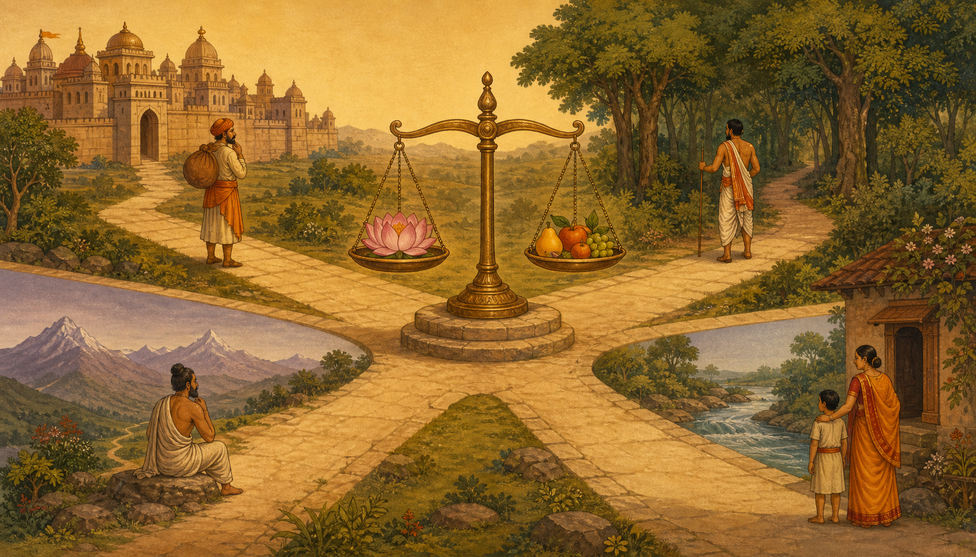
The argument has three claims. Action is unavoidable. Outcome is uncontrollable. Therefore: care about action precisely; care about outcome calmly. The verses below build that case.
1 · The thesis #
Bhagavad Gita 2.47
कर्मण्येवाधिकारस्ते मा फलेषु कदाचन।
karmaṇy evādhikāras te mā phaleṣu kadācana
You have a right to action, never to its fruit.
The Sanskrit word here is adhikāra: the right and the responsibility, both. You are the one who has to act. You are not the one who decides what the action produces. Make peace with that asymmetry or you will burn out trying to close it.
2 · The definition #
Bhagavad Gita 2.48
siddhy-asiddhyoḥ samo bhūtvā samatvaṁ yoga ucyate
Be the same in success and in failure. That evenness is what is called yoga.
“Same” does not mean indifferent. It means: the inner system does not amplify the outer signal. A 10x outcome does not 10x your mood. A failed quarter does not crater it. Equanimity is not numbness. It is bandwidth.
3 · The technical claim #
Bhagavad Gita 2.50
yogaḥ karmasu kauśalam
Yoga is skill in action.
Three Sanskrit words, no looser translation possible. The Gita is making an interesting move here: it is defining yoga not as a state achieved at rest but as a quality observable in motion. You cannot prove you have it on a cushion. You prove it by how you ship.
4 · Inaction is not an option #
Bhagavad Gita 3.5
na hi kaścit kṣaṇam api jātu tiṣṭhaty akarma-kṛt
No one can sit still, even for a moment, doing nothing.
Krishna closes off the easy escape. The “do nothing” answer is not on the menu. Action happens whether you choose it or not, because the body and the mind do not stop. The only choice is between unconscious action and conscious action. Choose conscious.
5 · Do the work in front of you #
Bhagavad Gita 3.8
niyataṁ kuru karma tvaṁ karma jyāyo hy akarmaṇaḥ
Do the work that is yours to do; action is better than inaction.
The word niyata matters here. It does not mean “any action”. It means the action that is fitted to you, in this role, at this moment. Discipline is not about volume. It is about doing the right next thing and not letting yourself sneak away to the wrong easier thing.
6 · Why this works #
Bhagavad Gita 3.19
tasmād asaktaḥ satataṁ kāryaṁ karma samācara
asakto hy ācaran karma param āpnoti pūruṣaḥTherefore, without attachment, perform the action that is to be done. The one who acts unattached attains the highest.
This is the operating instruction. Not “do less”. Not “care less”. Act unattached. The verb is active. Attachment, in the Gita’s vocabulary, is not love or care. It is the silent contract you sign with yourself that this outcome must be a particular way for you to be okay. That contract is what makes good people decide badly. Tear it up.
7 · Where it lands #
Bhagavad Gita 3.30
mayi sarvāṇi karmāṇi saṁnyasyādhyātma-cetasā
nirāśīr nirmamo bhūtvā yudhyasva vigata-jvaraḥSurrendering all actions to me, with mind fixed on the highest, free of expectation, free of “mine”, fight without fever.
The verb here is yudhyasva: fight. Krishna is not telling Arjuna to retreat into a calmer life. He is telling him to do the very hard, public, consequential thing that is in front of him. The instruction is precise: hand the action to a higher authority, drop the expectation, drop the ownership, and then fight without fever.
“Without fever” (vigata-jvara) is the line that should sit on every operator’s desk.
Next. If this guide held you, the natural sequel is chapter 12 of the Gita on Bhakti Yoga, or the Japji 12 stanzas guide for a different framing of the same problem.
यही कथा वहाँ भी
- अध्याय 3: कर्म योग
भगवद्गीता अध्याय 3: कर्मयोग - अध्याय 5: कर्म संन्यास योग
भगवद्गीता अध्याय 5: कर्म-संन्यास योग - अनुगीता · अश्वमेध पर्व
अनुगीता (अश्वमेध पर्व): कृष्ण का कर्म पर पुनः विवेचन